MAE (Mean Absolute Error)
The average distance between your predictions and reality. Lower is better.
The average distance between your predictions and reality. Lower is better.
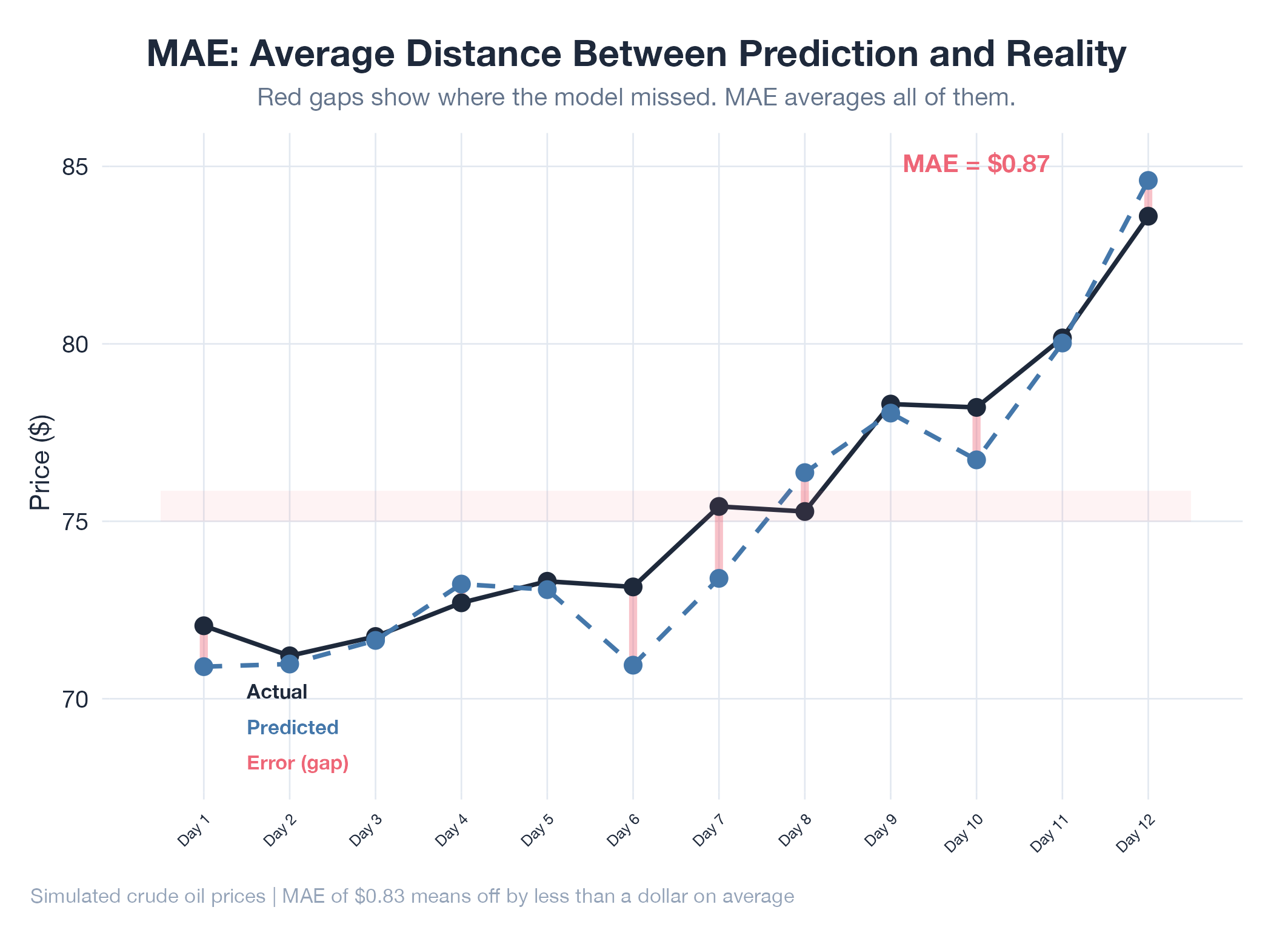
Mean Absolute Error answers the simplest question about predictions: on average, how far off are you? Take every prediction, subtract the actual value, ignore the negative sign (that’s the “absolute” part), and average them all. The units match whatever you’re predicting: dollars, degrees, percentages: making results immediately intuitive. Unlike RMSE, MAE treats every unit of error equally: a $5 miss counts exactly five times more than a $1 miss, with no hidden squaring.
How It Works
MAE = mean(|predicted − actual|). An MAE of $0 means perfect predictions. The scale matches your target variable, so “MAE = $0.83” means “off by 83 cents on average.”
Example
The oil model achieved a one-step MAE of $0.833 on WTI crude futures: 13% better than the prior version. With oil trading $60–85/barrel, being off by less than a dollar is strong performance. Measured in Oil v16 Sell Model.