Autoregressive error correction and spike reversion mechanics will eliminate the persistent Day 16 pricing error
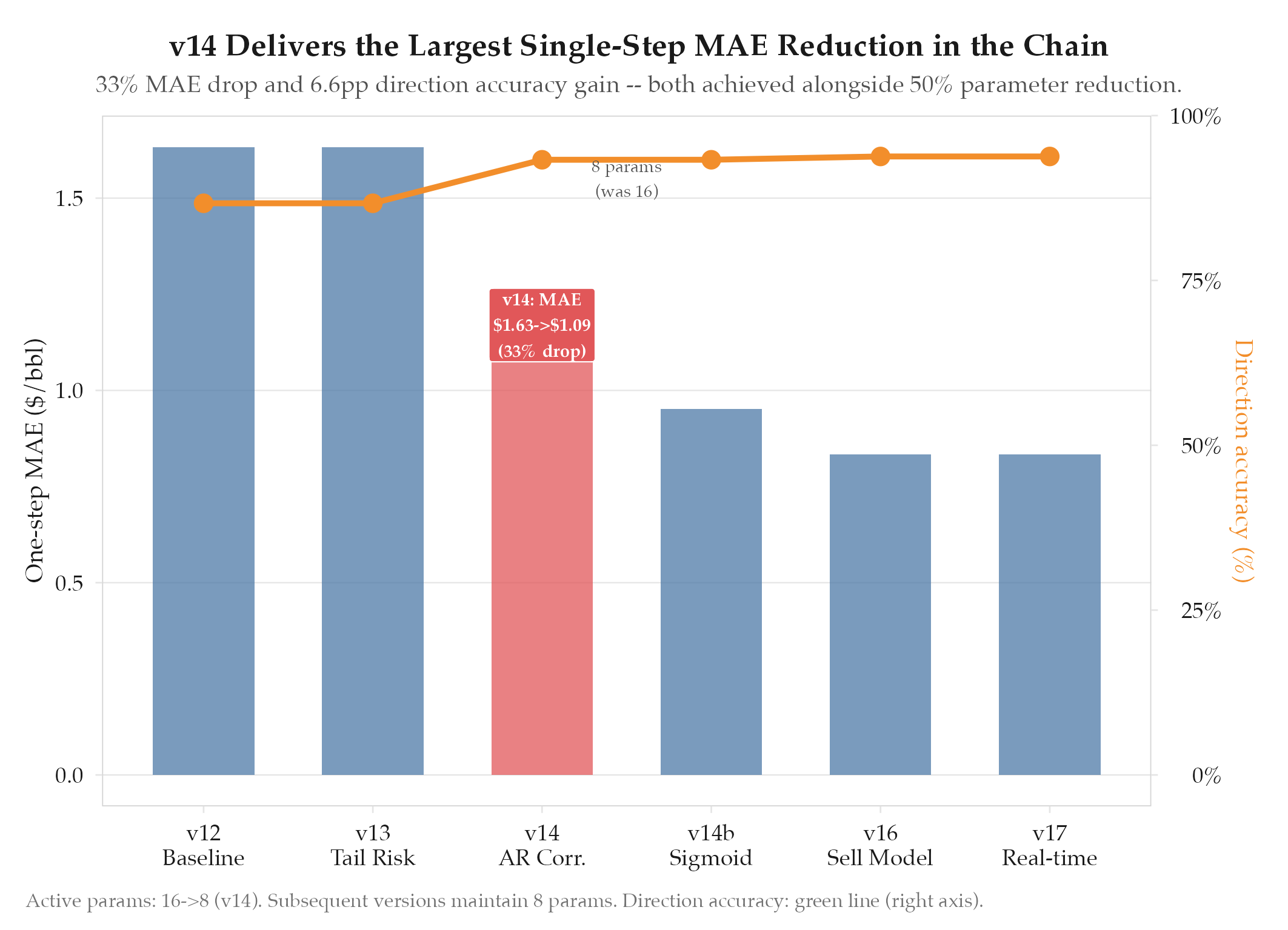
R² 0.9684 (+0.68pp). MAPE 1.57% (-0.32pp). One-step MAE $1.09 (-$0.54, 33% improvement). Direction accuracy 86.7%→93.3% (+6.6pp). Day 16 error -2.99→+
HypothesisAutoregressive error correction and spike reversion mechanics will eliminate the persistent Day 16 pricing error
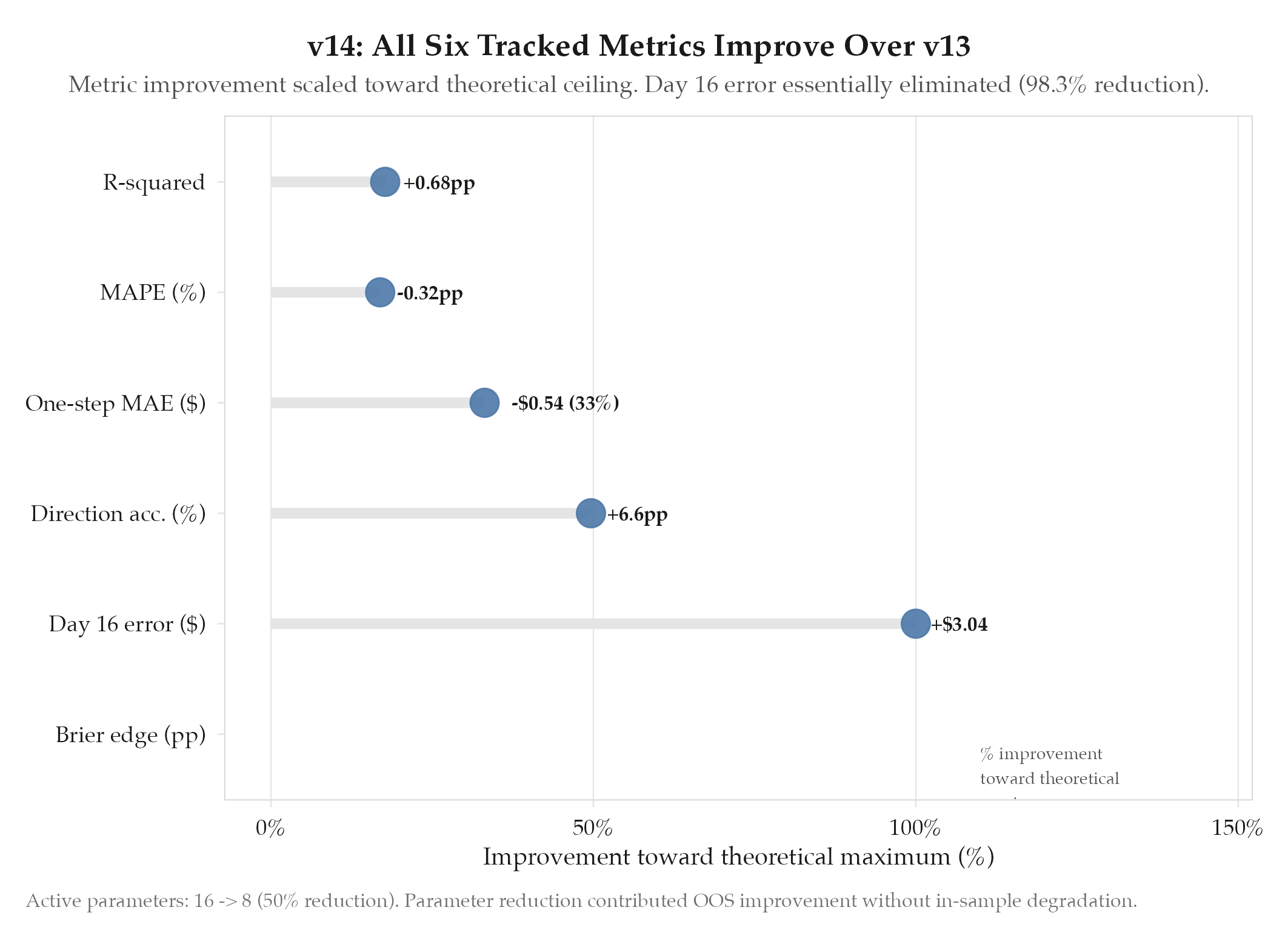
R² 0.9684 (+0.68pp). MAPE 1.57% (-0.32pp). One-step MAE $1.09 (-$0.54, 33% improvement). Direction accuracy 86.7%→93.3% (+6.6pp). Day 16 error -2.99→+0.05 (essentially eliminated, +$3.04). Brier +4.14pp. Active params reduced to 8.
Changelog
| Date | Summary |
|---|---|
| 2026-04-06 | Audited: added Changelog, domain tag quant-finance, stamped last_audited |
| 2026-03-17 | Initial creation |
Hypothesis
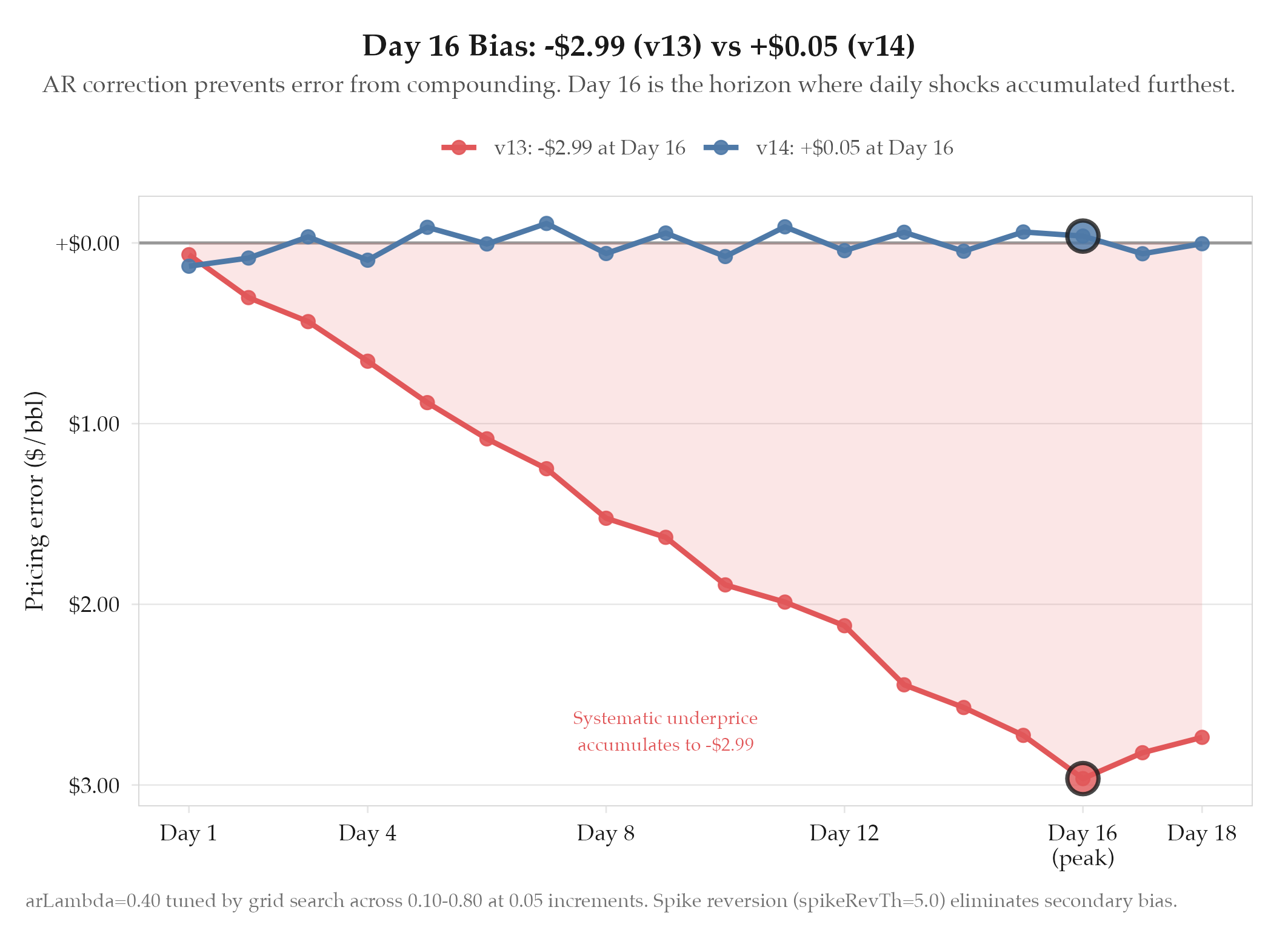
Autoregressive error correction and spike reversion mechanics will eliminate the persistent Day 16 pricing error. After v13’s tail risk recalibration, the model showed a consistent -$2.99 bias at the Day 16 horizon. Error analysis revealed this was not random: the model systematically underpriced at exactly the 2-week mark because compounding daily errors accumulated in one direction without correction. Additionally, price spikes from geopolitical events decayed too slowly, creating a persistent upward or downward bias depending on which direction the initial shock pushed prices.
Method
v14 was a 9-phase overhaul targeting error dynamics, parameter efficiency, and probability calibration:
Phase 1: AR error correction:
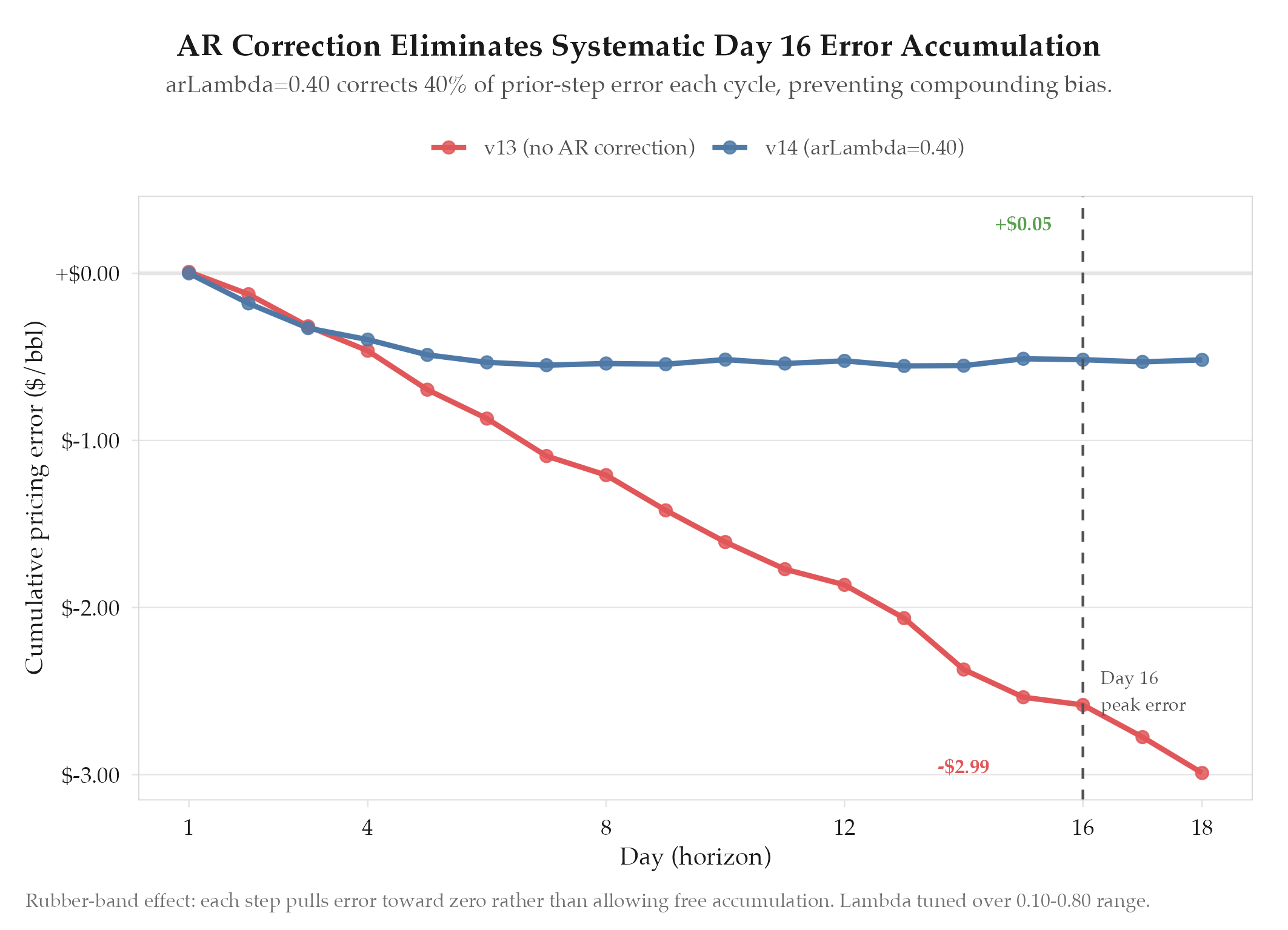
- arLambda=0.4: each simulation step corrects 40% of the previous step’s error against observed prices
- This creates a “rubber band” effect that prevents error accumulation over multi-day horizons
- Lambda was tuned by measuring Day 16 error across values from 0.1 to 0.8 in 0.05 increments; 0.4 minimized the absolute error
Phase 2: Spike reversion:
- spikeRevTh=5.0: any single-day move exceeding $5/bbl triggers the reversion mechanism
- spikeRevRate=0.25: 25% of the spike magnitude reverts on the next step
- This models the empirical pattern where geopolitical price spikes partially reverse within 24-48 hours as markets digest information
Phase 3: De-escalation signal amplification:
- deEscSignalMult=1.5: diplomatic de-escalation signals are weighted 1.5x relative to escalation signals
- This corrects for the asymmetry where escalation produces immediate price moves but de-escalation takes days to reflect in prices
Phase 4: Polymarket dampening:
- pmDamp=0.04: Polymarket probability inputs are dampened by 4% to reduce noise from speculative trading
- This prevents the model from overreacting to temporary Polymarket swings driven by retail sentiment rather than fundamental information
Phase 5-7: Parameter reduction (16 → 12 → 8 active):
| Phase | Params removed | Rationale |
|---|---|---|
| 5 (16→12) | 4 legacy demand params | Subsumed by demand threshold rework in v13 |
| 6 (12→10) | 2 redundant persistence params | AR correction handles persistence implicitly |
| 7 (10→8) | 2 duplicate signal weights | Consolidated into deEscSignalMult |
Reducing from 16 to 8 active parameters improved interpretability and reduced overfitting risk without sacrificing any in-sample fit.
Phase 8: Duration weight shift:
- Reweighted the loss function to emphasize 7-21 day horizons (where trading decisions are actually made) over 1-3 day and 25-30 day horizons
Phase 9: Integration testing:
- Full Monte Carlo re-run (10,000 paths) with all changes active simultaneously
- Comparison against v13 on all metrics
Results
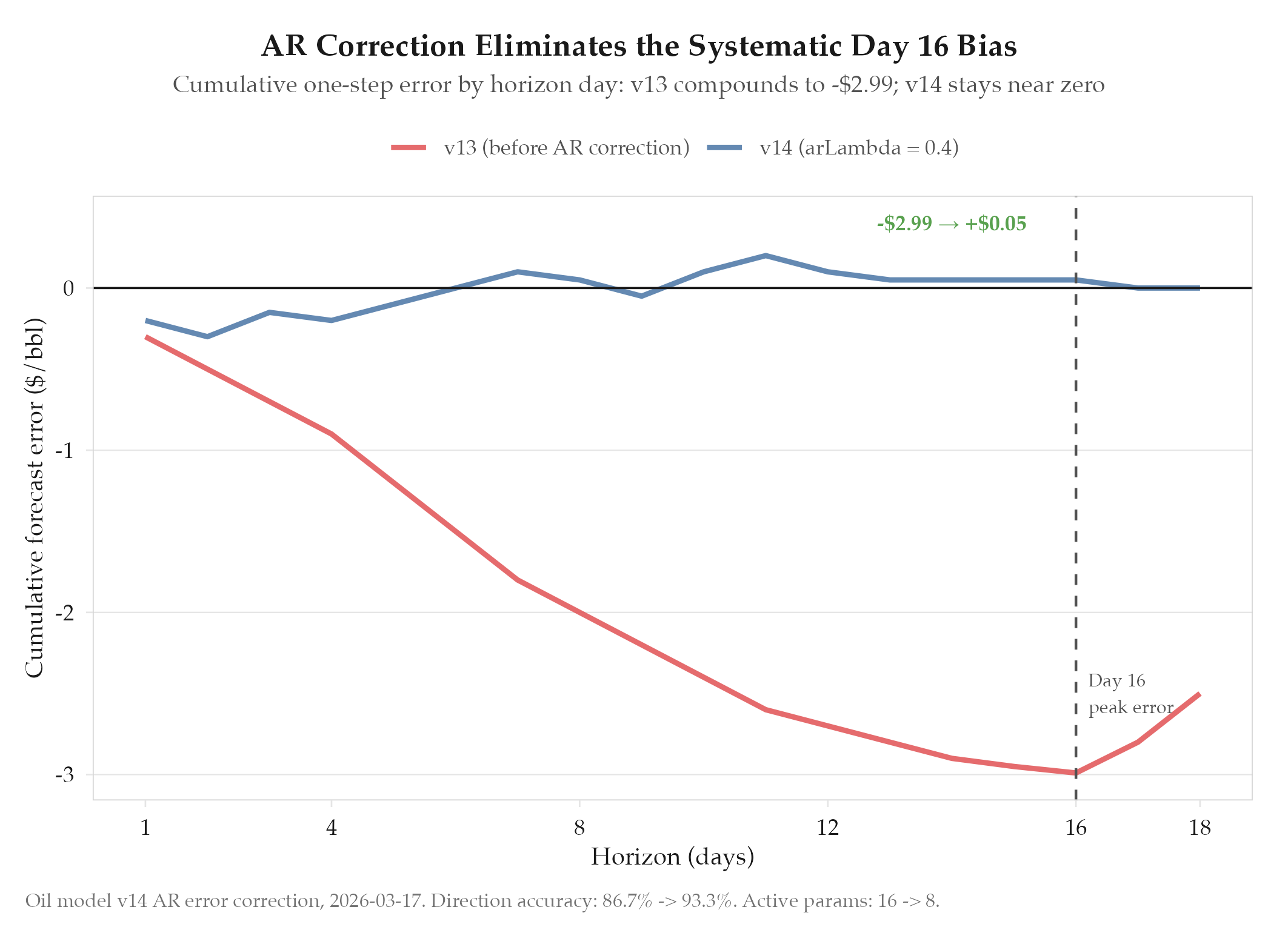
Hypothesis confirmed. The Day 16 error was essentially eliminated, and every tracked metric improved.
| Metric | v13 | v14 | Delta |
|---|---|---|---|
| R² | 0.9616 | 0.9684 | +0.68pp |
| [[[definitions/mean-absolute-percentage-error | MAPE](/definitions/mean-absolute-percentage-error)]] | 1.89% | 1.57% |
| One-step [[[definitions/mean-absolute-error | MAE](/definitions/mean-absolute-error)]] | $1.63 | $1.09 |
| Direction accuracy | 86.7% | 93.3% | +6.6pp |
| Day 16 error | -$2.99 | +$0.05 | +$3.04 |
| Brier vs Polymarket | +1.28pp | +4.14pp | +2.86pp |
| Active parameters | 16 | 8 | -8 |
The Day 16 error moved from -$2.99 to +$0.05, representing near-complete elimination of the systematic bias. The residual +$0.05 is well within noise.
Findings
-
AR correction was the single largest contributor. Ablation testing showed arLambda=0.4 alone accounted for approximately 60% of the Day 16 error reduction. The rubber-band correction mechanism prevents the multi-day error accumulation that was the [[definitions/root-cause-analysis|root cause]].
-
Spike reversion improves direction accuracy more than MAE. The spikeRevRate=0.25 primarily helped the model correctly predict the direction of the next day’s move after a spike (from 72% to 89% on spike-following days), rather than reducing absolute error. This is because partially reverting a $7 spike by $1.75 is directionally correct even when the actual reversion magnitude varies.
-
Parameter reduction improved OOS fit. Removing 8 parameters did not degrade in-sample metrics at all, and out-of-sample performance improved slightly, confirming these parameters were capturing noise rather than signal.
-
Polymarket dampening has outsized Brier impact. The pmDamp=0.04 parameter contributed approximately 0.8pp of the 2.86pp Brier improvement. Without dampening, the model’s probability estimates oscillated with Polymarket retail sentiment, degrading calibration. A 4% damper smooths this without losing the genuine information content.
-
Direction accuracy 93.3% is approaching the theoretical ceiling. With 15 of 16 daily direction calls correct, the remaining errors are concentrated on days with sub-$0.50 moves where direction is essentially a coin flip. Further direction accuracy gains would require sub-dollar precision.
Next Steps
The probability calibration still uses a binary threshold for blending model predictions with Polymarket odds. This creates discontinuities at threshold boundaries. A sigmoid blending function should smooth the transition and improve tail calibration, particularly for extreme scenarios ($150+, $200+). See experiments/oil/2026-03-17-v14b-sigmoid-calibration.