Futures Contract
An agreement to buy or sell something at a set price on a future date. The backbone of commodities.
An agreement to buy or sell something at a set price on a future date. The backbone of commodities.
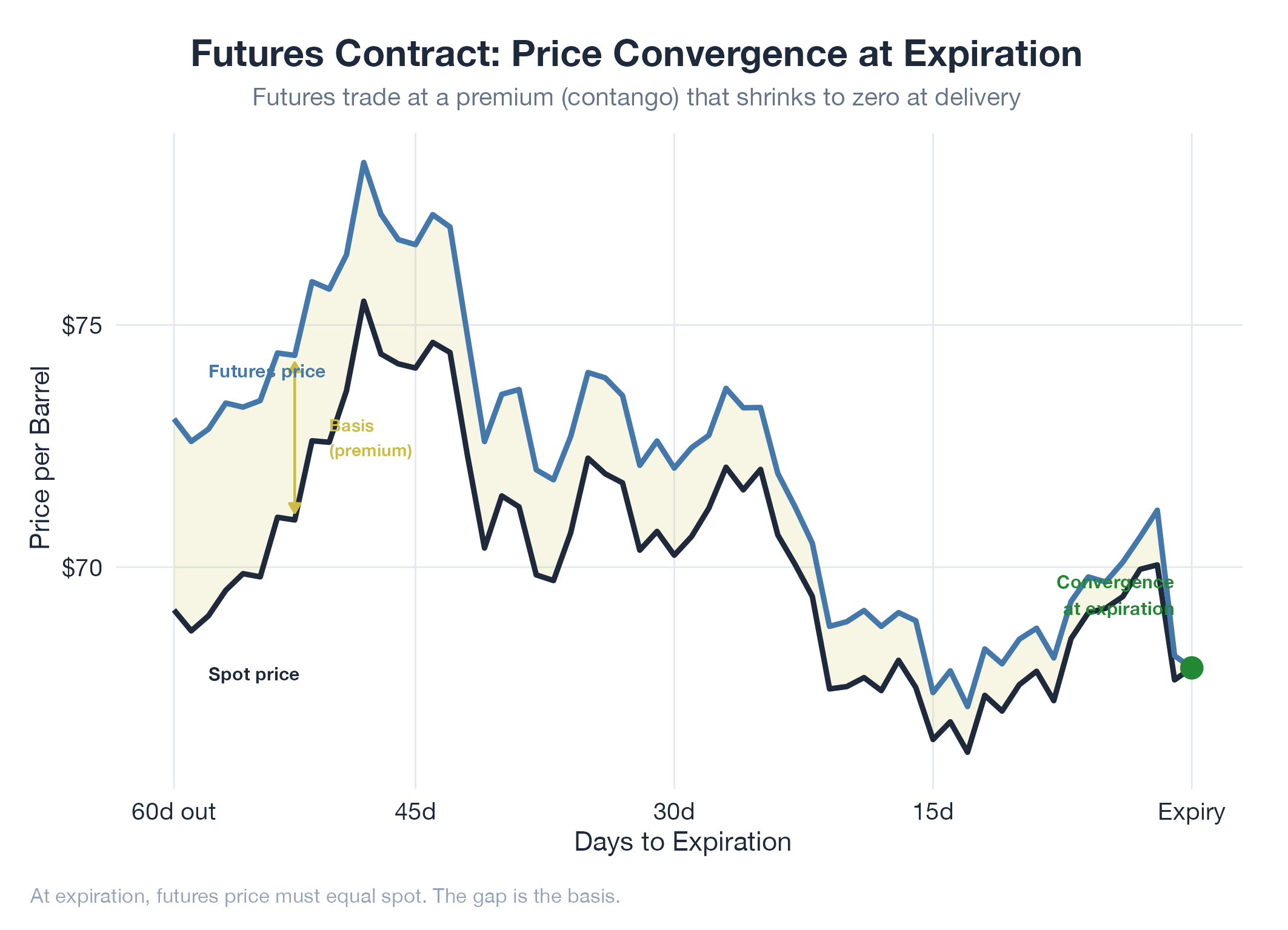
A futures contract is a standardized agreement to buy or sell an asset at a set price on a specific future date, traded on an exchange. The farmer locks in revenue selling wheat at today’s price for October delivery; the baker locks in input costs. Neither cares what the market does between now and then. Key mechanics: long positions profit when prices rise, short positions profit when they fall. Margin (5–15% of contract value) creates leverage. Most futures are closed before expiration: physical delivery rarely happens. The “CL” in cl-futures-hormuz is the CME’s WTI Crude Oil symbol: each contract = 1,000 barrels, so a $1 move means $1,000/contract.
How It Works
Open position at current price → mark-to-market daily (gains/losses settle each day, not at expiration) → close before expiry or take/make delivery. Term structure (near-month vs. far-month price difference) signals supply-demand imbalances.
Example
The oil model predicts CL front-month futures and tracks the term structure. During Hormuz tensions the model detected backwardation (near-month more expensive than far-month), indicating immediate supply concerns. This fed into sell trigger signals. Details in Oil v17 Realtime Consensus.