Sensitivity Analysis
Tweak each input and measure how much the output changes. Find which levers actually move the needle.
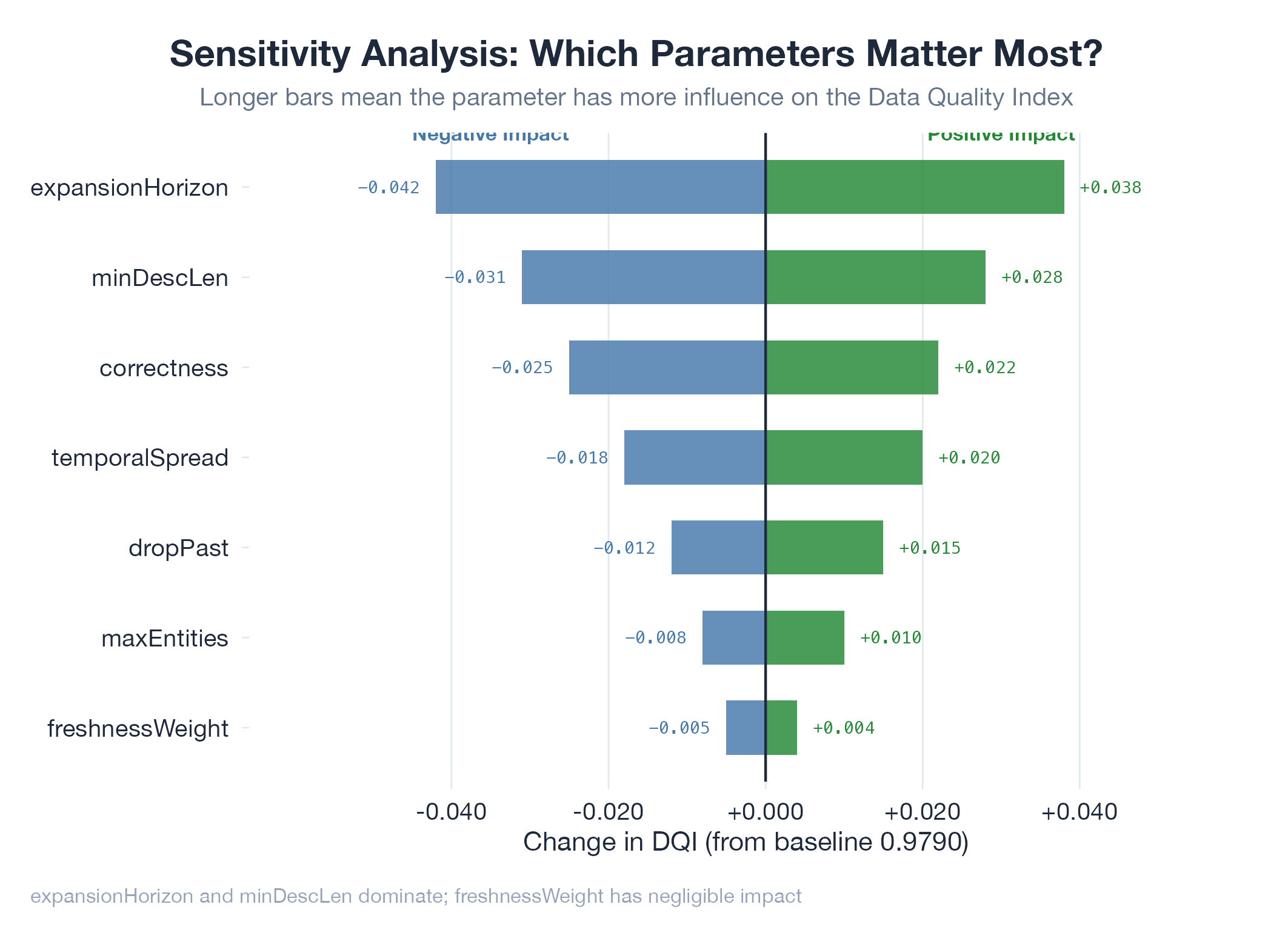
Sensitivity analysis finds which inputs actually control the output of your system. Vary each input while holding others fixed; inputs that cause large output swings are “sensitive” and deserve careful tuning. Inputs that barely move the needle can be set to reasonable defaults and safely ignored. Two flavors: local (one-at-a-time, simple) and global (Sobol indices, captures interactions between inputs). In practice: start local to identify the top 3–5 most influential inputs, then run global on just those to understand their interactions.
How It Works
Baseline configuration → change one input by ±10% → measure output change → repeat for every input → rank by influence → tornado chart. Local analysis is O(n) evaluations; global analysis is O(n²) but catches interaction effects.
Example
The oil model’s sensitivity analysis revealed the MC time window as the dominant lever: moving from 90 to 360 days had 4x the impact of any other parameter. This shaped the ratchet strategy directly: concentrate tuning effort on time window before touching decay rates or scenario probabilities. Local analysis identified the winner in O(n) evaluations.