Proof of Concept
Build the smallest possible version to prove the idea works before investing fully.
Build the smallest possible version to prove the idea works before investing fully.
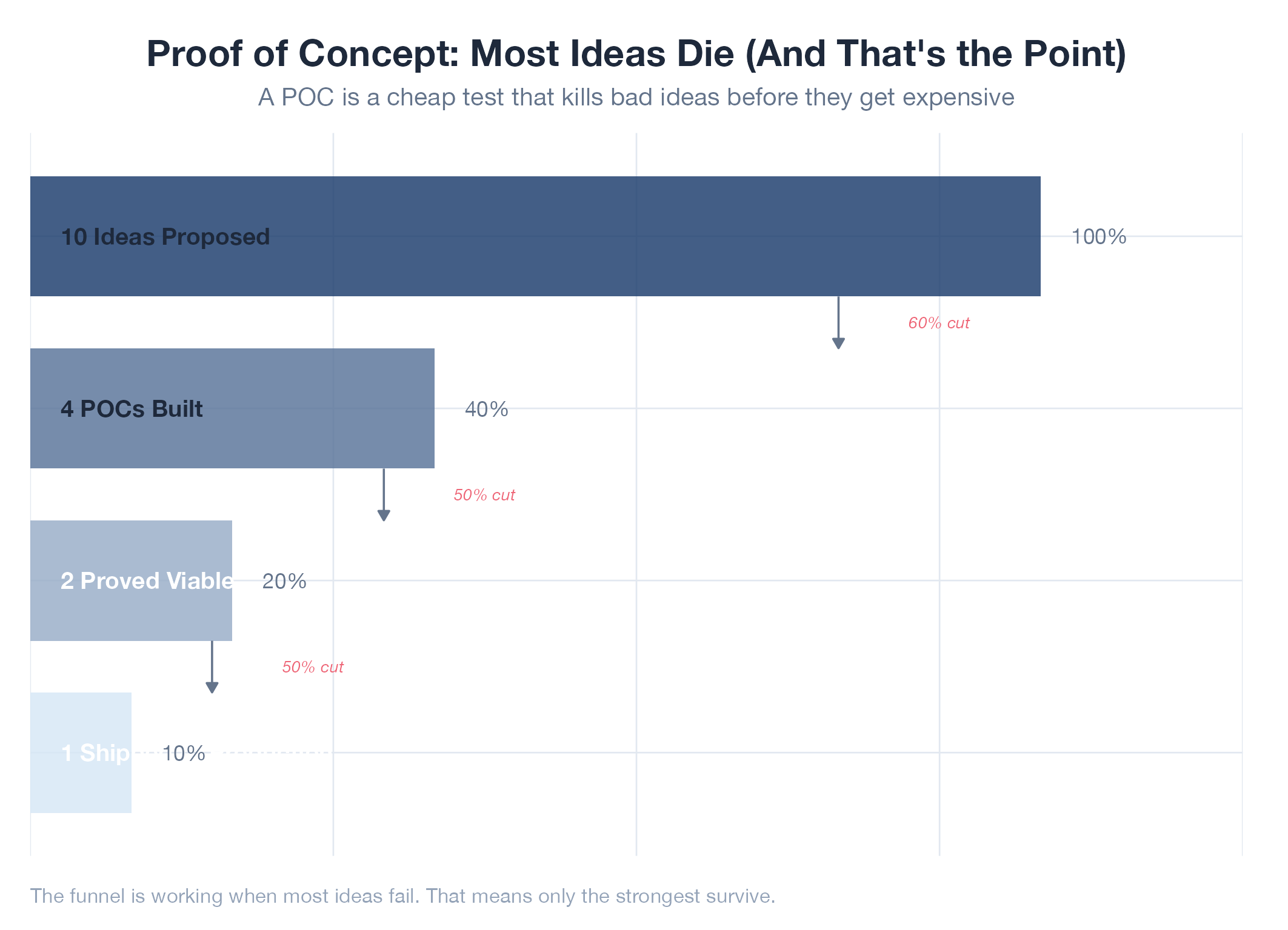
A proof of concept builds the smallest, roughest, most minimal version of an idea that can demonstrate the core mechanism works: not the whole product, just the one thing that, if it doesn’t work, means the entire project is dead on arrival. Deliberate constraints: hardcode everything irrelevant, use mock data, skip authentication, ignore edge cases. Define the success criterion before touching a keyboard. Critical rule: PoC code is throwaway. When the PoC passes, rebuild properly from scratch. Extending a PoC into production is how you get a codebase that’s 60% duct tape.
How It Works
Identify the core risk (the one thing that kills the project if infeasible) → build only what tests that risk → define a pass/fail criterion upfront → make the go/no-go decision. No ambiguity: a PoC that’s “kind of working” hasn’t answered the question.
Example
Dakka v0.10 PoC asked: can a parallel Claude Code orchestrator manage multiple agent sessions via WebSocket? The PoC proved the spawn/kill lifecycle and WS communication worked, greenlighting the full Rust migration to rusty-dakka (7,800 lines, 5 crates). PoC code was discarded; production system built fresh. Architecture at Dakka.