Greedy Parameter Sweep
Try every combination of settings, pick the best. Brute force but reliable when done right.
Try every combination of settings, pick the best. Brute force but reliable when done right.
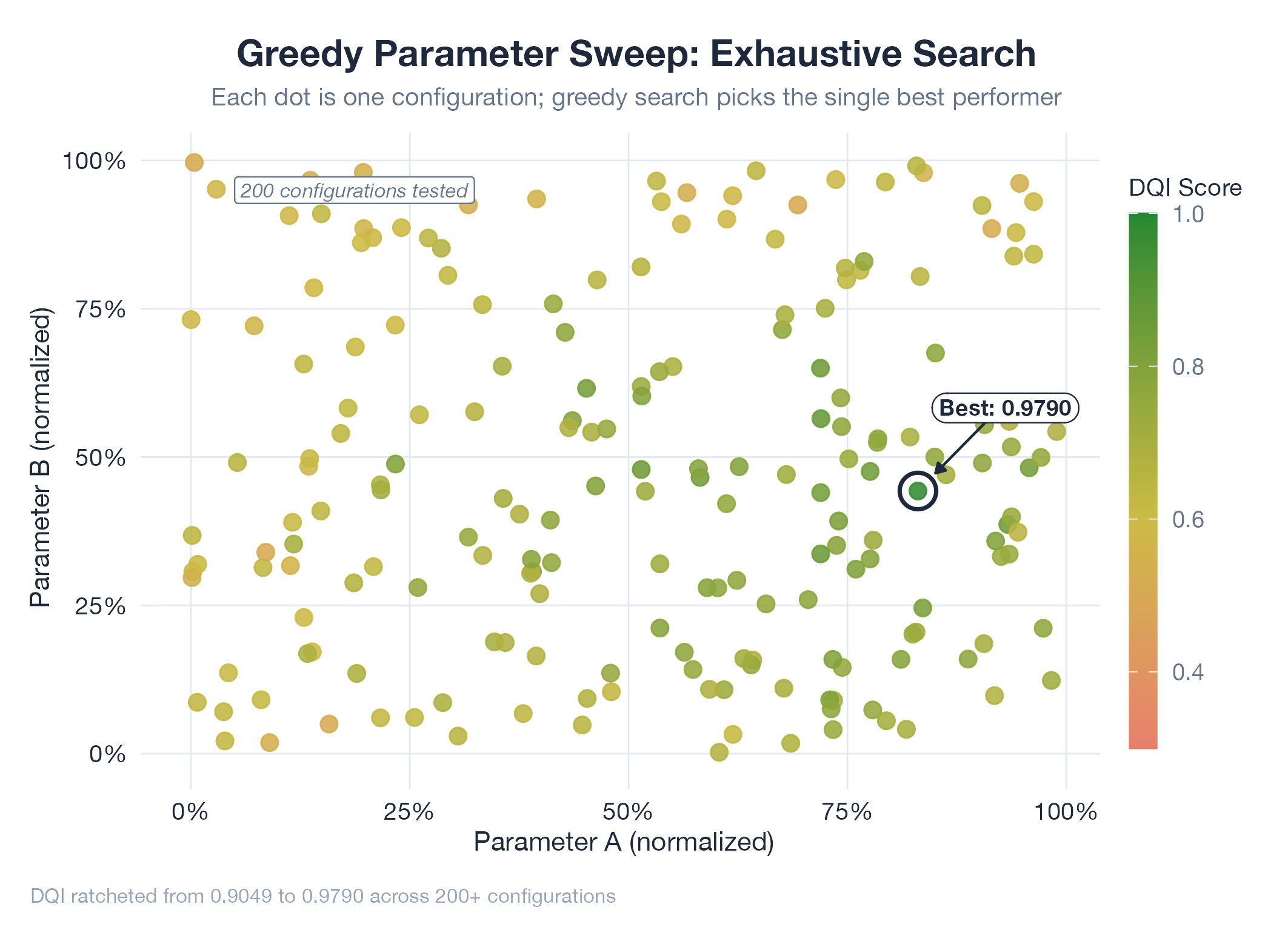
A greedy parameter sweep tries every combination in a defined grid and picks the highest-scoring one. No clever algorithms, no statistical shortcuts: just exhaustive testing. The “greedy” label means you’re optimizing for the single best measurable outcome right now, without thinking about exploration-exploitation tradeoffs. The key property other methods lack: completeness. If the best answer is on your grid, the sweep will find it. Practical refinement: coarse-to-fine sweeping (wide grid first, fine grid around the best region) gets precision without the cost of a full fine-grained sweep.
How It Works
Define grid (list of values per parameter) → run every combination → sort by metric → inspect top 5–10 (if the winner is an outlier surrounded by poor results, it may be overfitting) → validate on held-out data.
Example
The oil model’s v14b sweep covered 9 parameters with over 200 configurations, each evaluated on 90 days of WTI data using MAE, MAPE, and R². Sweet spot: 360-day time window, 10,000 MC samples. Seven of nine parameters then locked via Karpathy ratchet; two flagged for further exploration. Referenced in Oil v16.