Lifecycle Chain
The connective tissue of this lab: failure to pitfall to experiment to breakthrough. Nothing is wasted.
The connective tissue of this lab: failure to pitfall to experiment to breakthrough. Nothing is wasted.
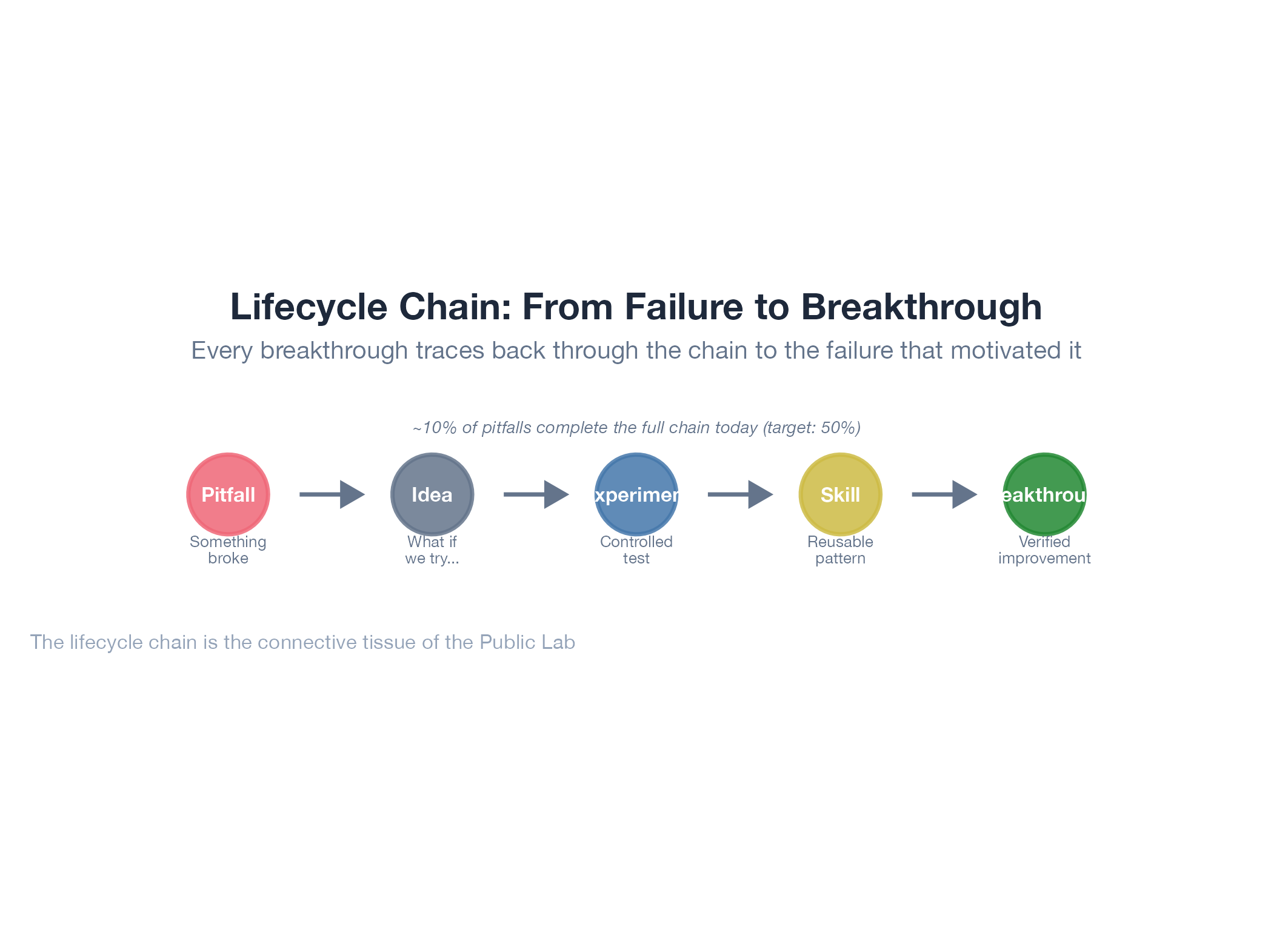
The lifecycle chain traces how knowledge moves through this vault: a bug becomes a pitfall, a pitfall becomes a research question, a research question becomes an experiment, an experiment produces either a breakthrough (chain advances) or a new pitfall (chain loops back, wiser). Nothing is wasted. The chain isn’t linear: it’s a directed graph with cycles. A breakthrough in one project might reveal a pitfall in another. Key metrics: edge density (every node targets ≥2 edges), orphan rate (target <10%), and experiment-to-breakthrough conversion rate (currently ~50%).
How It Works
Six dimensions form the nodes: Bugs → Pitfalls → Research → Ideas → Experiments → Breakthroughs. Every note should link forward (what this enables) and backward (what problem it addresses). The Sankey diagram on the Public Lab website visualizes these flows.
Example
The LinkedIn engine’s path: session crash (bug) → shadow DOM as a systematic obstacle (pitfall) → CDP pierce capability (research) → anti-detection experiment → 100% submission rate (breakthrough) → new pitfalls from account restrictions → chain restarts. The full path is tracked via Lifecycle Chain Audit.