Chaos Engineering
Deliberately break things in production to find weaknesses before real failures do.
Deliberately break things in production to find weaknesses before real failures do.
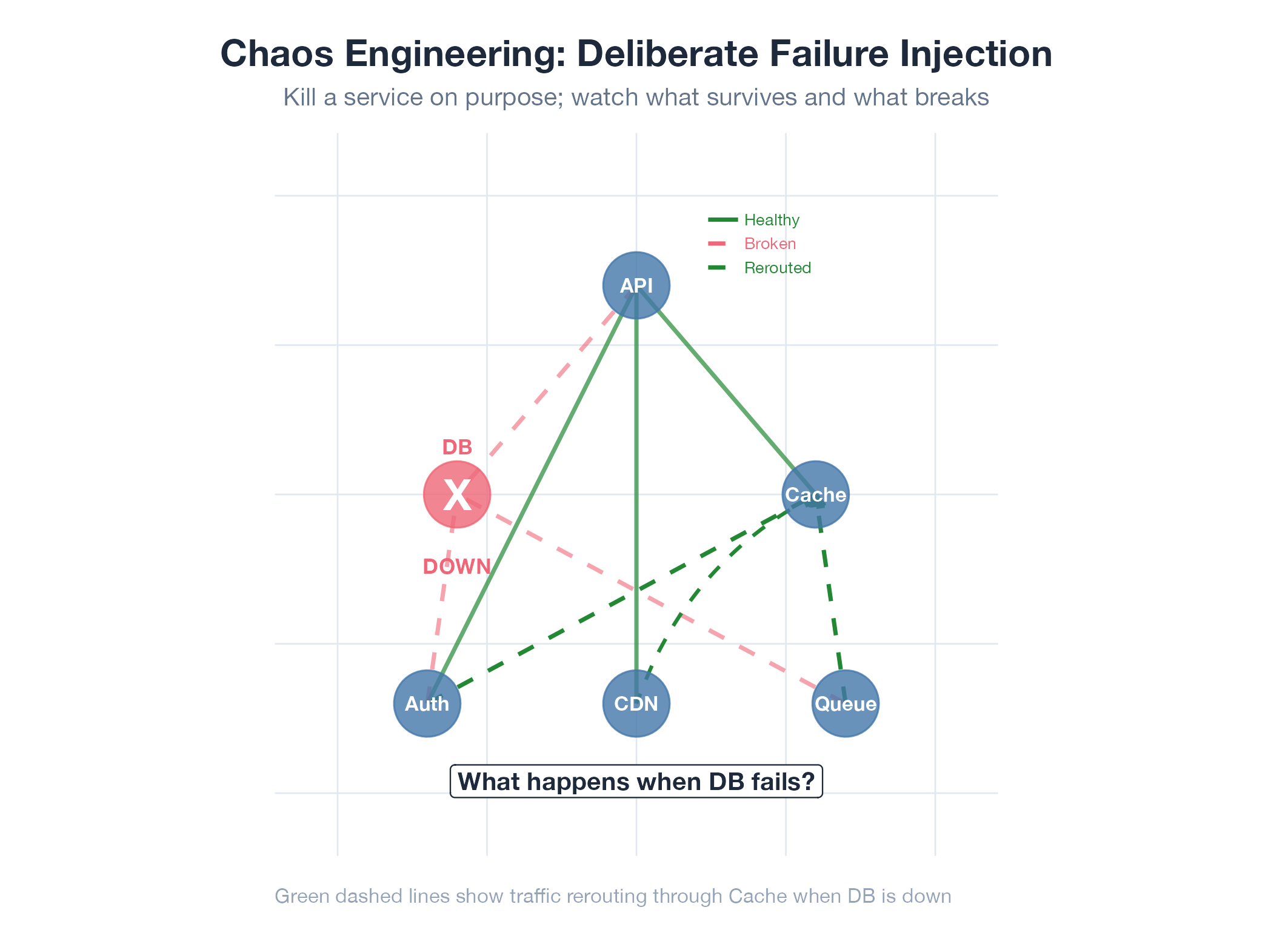
Chaos engineering deliberately introduces failures into a production system: kill a server, slow a database, corrupt a network packet, simulate a cloud region going down: then watches what happens. The philosophy: if your system can’t survive a random server dying on a Tuesday afternoon, it definitely can’t survive a real outage at 3 AM on Black Friday. Netflix pioneered this with Chaos Monkey, which randomly terminates production instances during business hours. Every chaos experiment follows a scientific method: define steady state, form a hypothesis, inject failure, observe divergence, learn and harden.
How It Works
Define steady state (latency < 200ms, error rate < 0.1%) → hypothesize behavior under failure → inject fault → compare to steady state → fix weaknesses. Start small: one instance, then a whole zone. Kill switches required.
Example
The LinkedIn engine’s 10-run progression is effectively chaos engineering performed by production itself: each run surfaced failures that deliberate fault injection would have caught earlier: scroll-loading, shadow DOM, hydration timing. The progressive deployment philosophy of “seek failures rather than wait for them” mirrors chaos engineering. Project context at Jobs Apply.