LinkedIn submission rate ratchet: 40% to 83% over 7 runs
40% submission success rate, Run 1 -> 83% submission success rate, Run 7. 26 individual failure fixes (F1-F39). Modal detection: 100%.
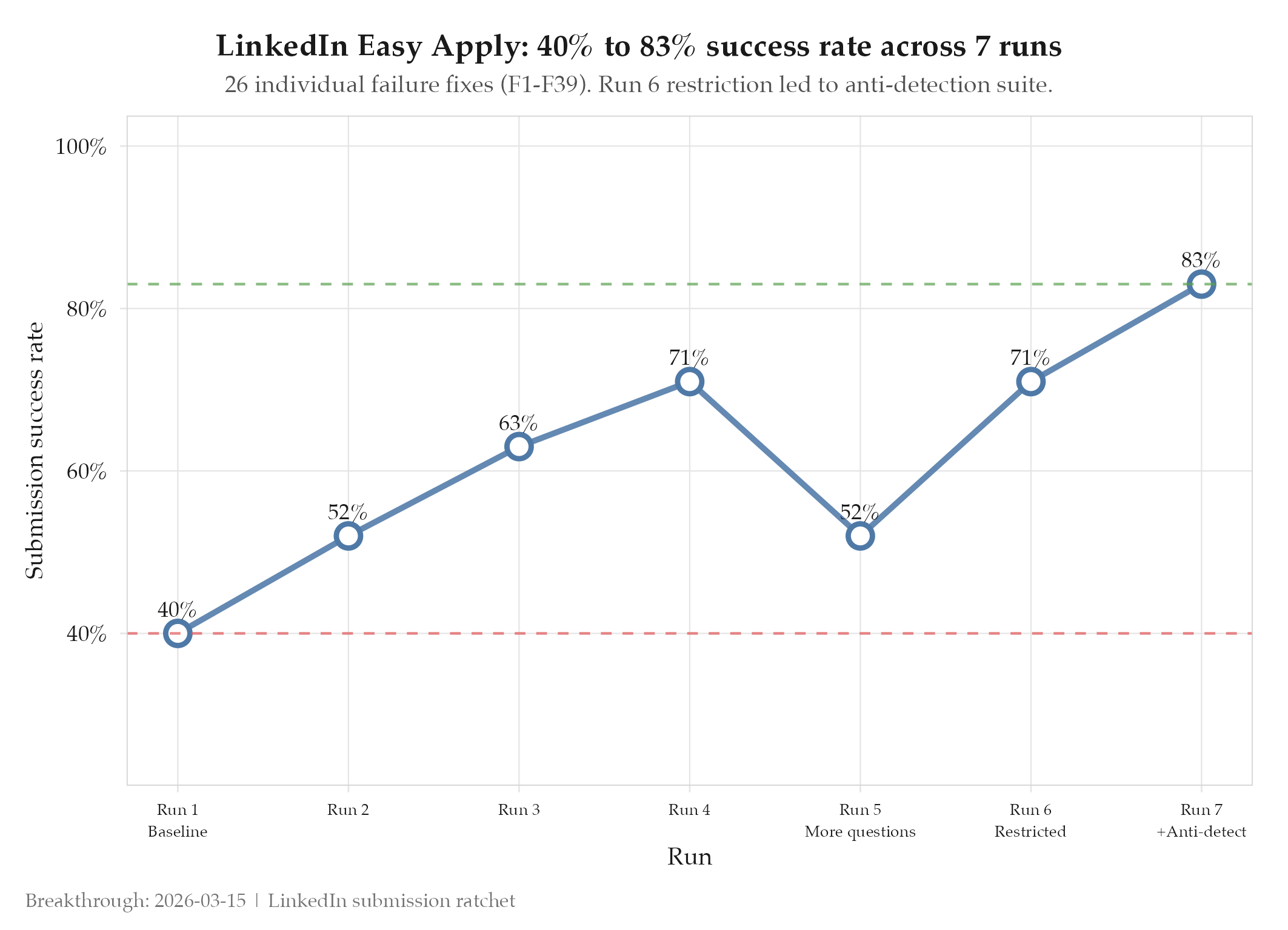
40% to 83%. Seven iterative runs, 26 targeted fixes, and one account restriction that forced a defensive detour. The ratchet pattern applied to browser automation at full fidelity.
Context
The first LinkedIn Easy Apply run in March 2026 achieved 40% submission success: meaning 6 in 10 automated applications failed silently or with unhandled errors. The failures were not random: each run exposed a specific new failure layer that had been hidden by earlier failures. The goal was to systematically eliminate each failure class rather than patch symptoms, using a ratchet approach: measure, hypothesize, fix, measure again. Progress should only go forward.
The complication in Run 6 was an account restriction triggered by behavioral detection: too many submissions, too quickly, with no reading dwell time. The restriction became its own forcing function for the anti-detection suite.
What Changed
Runs 1 through 5 addressed click-level and form-level failures: modal detection timing (the 3s initial + 4s DOM check two-attempt strategy), Easy Apply button identification, form field selectors, screening question patterns, and state machine edge cases. By Run 5 the submission logic was mechanically sound.
Run 6 exposed the account restriction problem. Runs 6 and 7 layered in gaussian timing distributions, reading simulation, and mouse movement patterns that mimic human behavior. The modal detection loop: which achieved 100% success in Run 7: required understanding the full lifecycle of the Easy Apply modal: when it appears, when it doesn’t, and how to recover from the intermediate states.
26 discrete failure fixes (F1–F39) were documented and addressed across 7 runs.
Impact
Submission success rate climbed from 40% to 83% over 7 runs spanning 14 days.
Before: 40% success rate, Run 1, 2026-03-15. 6 in 10 applications failing. After: 83% success rate, Run 7, 2026-03-29. Modal detection loop at 100% for Strategy-1. 26 failure modes eliminated.
The 108% relative improvement in submission rate meant more applications reaching the employer per session. This ratchet chain continued: see the follow-on breakthrough at breakthroughs/2026-04-02-jobs-apply-100-percent-linkedin.