Multi-channel pivot: LinkedIn limit triggers Direct and Greenhouse orchestration
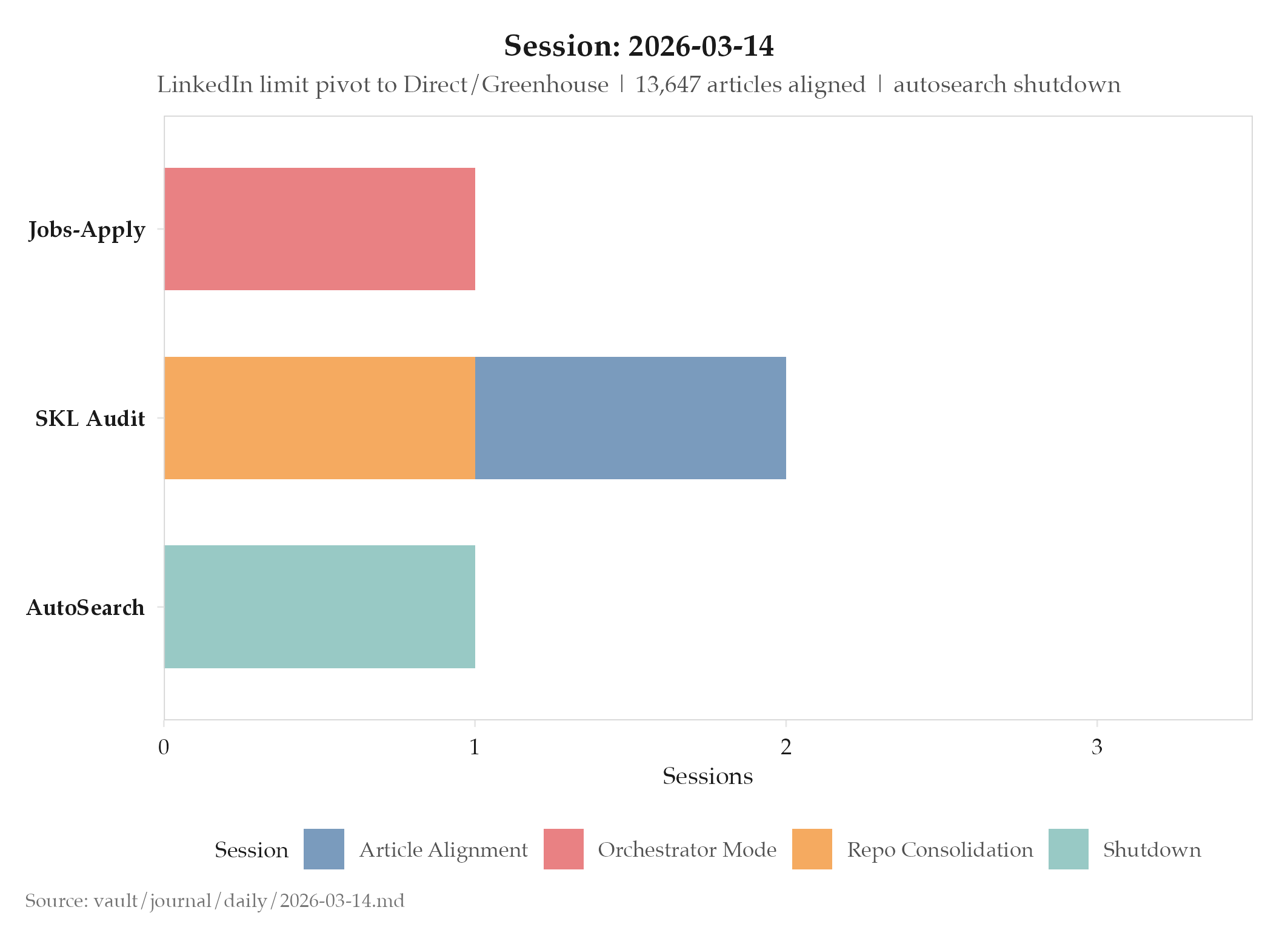
2026-03-14
Signal
Hitting the LinkedIn daily application limit and immediately pivoting to orchestrate Direct and Greenhouse workers proves that multi-channel architecture isn’t just about volume: it’s a resilience strategy that keeps the pipeline running when any single channel becomes temporarily unavailable.
Evidence
- Project: projects/jobs-apply/_index: Hit LinkedIn daily application limit; pivoted to orchestrating Direct and Greenhouse workers (30 submissions each as target); 106 automated autohunt code-review sessions
- Channel pivot: No downtime: LinkedIn limit hit, Direct and Greenhouse workers activated within the same session
- Project: internal audit: Full Article Content Alignment Audit implemented; evaluates 13,647 seed articles across 909 places for content-place relevance
- Architecture decision: Consolidated internal audit pipeline and internal-sync-server into a single repository after investigating the architectural separation
- Event: AutoSearch project shut down: sub-agents and ports stopped; project winding down in favor of consolidated autojob pipeline
So What (Why Should You Care)
The LinkedIn limit pivot is a real-world validation of multi-channel architecture. The daily limit didn’t stop the day’s work: it redirected it. This resilience property is the same reason distributed systems are designed to route around failures: not because failures are rare, but because they’re inevitable. LinkedIn limits, rate limits, platform outages, and account restrictions are all predictable failure modes when you’re running automated pipelines at scale.
If you design a single-channel pipeline, any channel failure is a full stop. If you design a multi-channel pipeline, a channel failure is a routing decision. The engineering cost of building multi-channel support upfront is almost always less than the operational cost of the downtime and rework when a single-channel pipeline hits an unexpected limit.
The internal audit Full Article Content Alignment Audit (13,647 seed articles across 909 places) also demonstrates the value of auditing the relationship between content and its assigned entity, not just checking that the content exists. An article that exists but isn’t relevant to its place is worse than no article: it occupies a slot in a quality system while contributing negative signal. Evaluating content-place relevance directly is what separates a quality system from a count system.
At 13,647 seed articles across 909 places, the audit scope is substantial. That’s an average of 15 seed articles per place: enough to evaluate whether there’s a diversity of content (different event types, different seasons, different aspects of the place’s offerings) or whether the same type of content is duplicated repeatedly. Diversity of coverage is itself a quality signal that a simple article count doesn’t capture.
The AutoSearch shutdown today is also worth noting as a quality decision. Two parallel projects serving the same domain (autosearch and autojob) create coordination overhead and codebase fragmentation. Shutting down the older project in favor of the consolidated one reduces maintenance burden and clarifies where future improvements should go. The decision to consolidate is itself a quality improvement: not to any single codebase, but to the overall system architecture.
The 106 automated code-review sessions on autohunt during the LinkedIn limit pivot demonstrate that even during an orchestration session (directing workers rather than writing code), the downstream code changes from worker activity still generate review sessions. The pipeline’s self-audit runs continuously regardless of what the operator is doing.
What’s Next
- Validate Full Article Content Alignment Audit results across the 13,647 seed articles
- Complete internal audit pipeline and internal-sync-server repository consolidation
- Plan Direct channel campaign for next run
Log
- projects/jobs-apply/_index: hit daily LinkedIn application limit: immediately pivoted to Direct and Greenhouse orchestration
- Orchestrated Direct workers targeting 30 submissions; Greenhouse workers targeting 30 submissions
- 106 automated autohunt code-review sessions
- internal audit: Full Article Content Alignment Audit implemented
- 13,647 seed articles across 909 places evaluated for content-place relevance
- Investigation into architectural difference between internal audit pipeline and internal-sync-server: consolidation decision made
- AutoSearch: shut down sub-agents and ports; project winding down in favor of consolidated autojob pipeline