Light day: jobs-apply maintenance and a deep Documents-wide exploration
2026-03-13
Signal
A low-intensity day split between jobs-apply session maintenance and one large Documents-wide exploration session. This is the kind of day that does not produce headlines but keeps the machinery running and seeds the investigations that turn into next week’s feature work.
Evidence
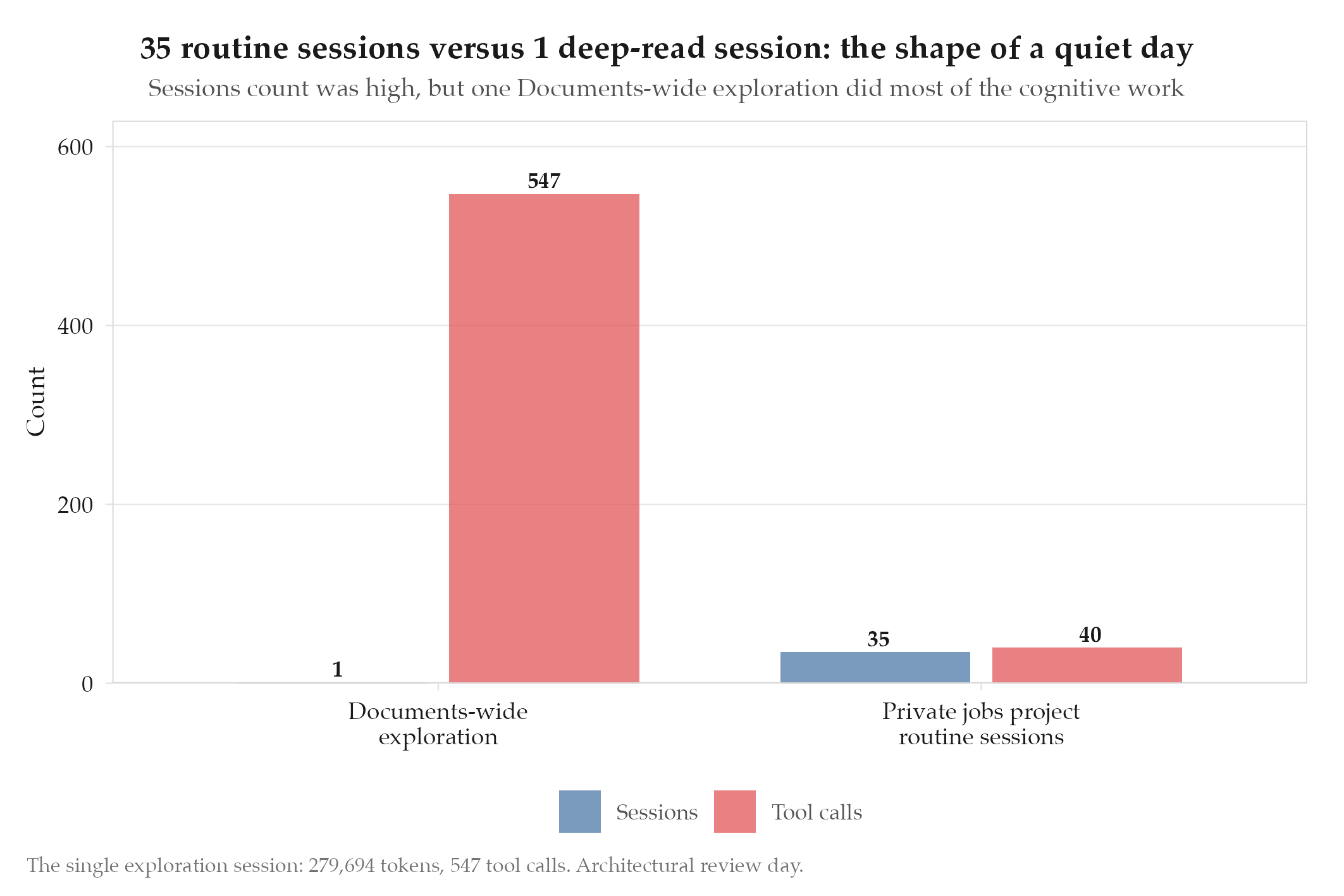
35 jobs-apply sessions ran with minimal token usage each, consistent with routine agent runs rather than active development. One large Documents-level session burned 279,694 tokens and executed 547 tool calls, which is a deep codebase exploration session. Token-to-tool-call ratio suggests heavy file reading with moderate editing, more audit than refactor.
No new features shipped. No commits of consequence. The focus was on monitoring the existing systems and on reading across projects to build up the mental model that makes later work faster. The 35 short jobs-apply sessions plus the single deep Documents session is a classic two-mode day: lots of small health checks on one side, one big reading sprint on the other.
So What
Not every day produces a headline. The large Documents session looks like architectural review or cross-project analysis. These exploration days often inform the breakthroughs that follow in subsequent sessions, because the expensive part of a big refactor is usually the loading-in phase, not the edit phase. When you have already spent a day reading, the next day you can ship in half the time.
Days like this also serve as a correction mechanism. If all your days look like this, you are stuck. If none of your days look like this, you are shipping without context and the bugs compound. A healthy cadence has one of these every week or two, depending on how fast the surrounding systems are changing.
The pattern of 35 small jobs-apply sessions with minimal activity is worth a quick look. If those sessions are genuine pipeline health checks, this is the signal of a mature system doing its job. If they are agent loops that spin up, find nothing, and exit, that is a different problem. The token counts being small in both cases makes the distinction hard to draw from metrics alone, which is itself something to fix.
What’s Next
The Documents-wide session almost certainly surfaced something. The next action is to find out what. I want to check whether that session left any durable artifacts: commits, notes, a skill update, even a scratch file. If it did, follow the thread. If it did not, I have evidence that a large exploration session can evaporate on exit unless I build the artifact habit into the workflow.
I also want a cheap way to distinguish “pipeline health check” from “agent loop” in the short jobs-apply sessions. Even a single log line per session tagged with intent would be enough to read the day correctly in retrospect.
The pairing of many-small-sessions plus one-large-session is worth calling out as a template. It shows up often enough in my daily logs that it probably represents a natural working rhythm: scheduled ops running on their own cadence, plus one deep-dive block where I actually think. When I see that shape, the day usually produced real learning even if the commits are thin. When I see just the many-small part without the deep dive, the day tends to feel busy but hollow. The lesson is to protect the deep-dive block, because that is where the next week’s ideas actually come from.
Log
- Sessions: 35 jobs-apply + 1 Documents
- Top projects: jobs-apply (routine), Documents (deep exploration)
- Commits: minimal, monitoring-mode day
- Notable: 279,694 tokens and 547 tool calls in a single exploration session