92.3% LinkedIn success reveals the remaining failures need architecture, not tuning
2026-03-12
Signal
Reaching 92.3% LinkedIn Easy Apply success after 2 iterations reveals that the remaining 7.6% failure rate isn’t random noise: it’s a predictable category (external apply redirects) that requires a different architectural solution, not more tuning of the existing one.
Evidence
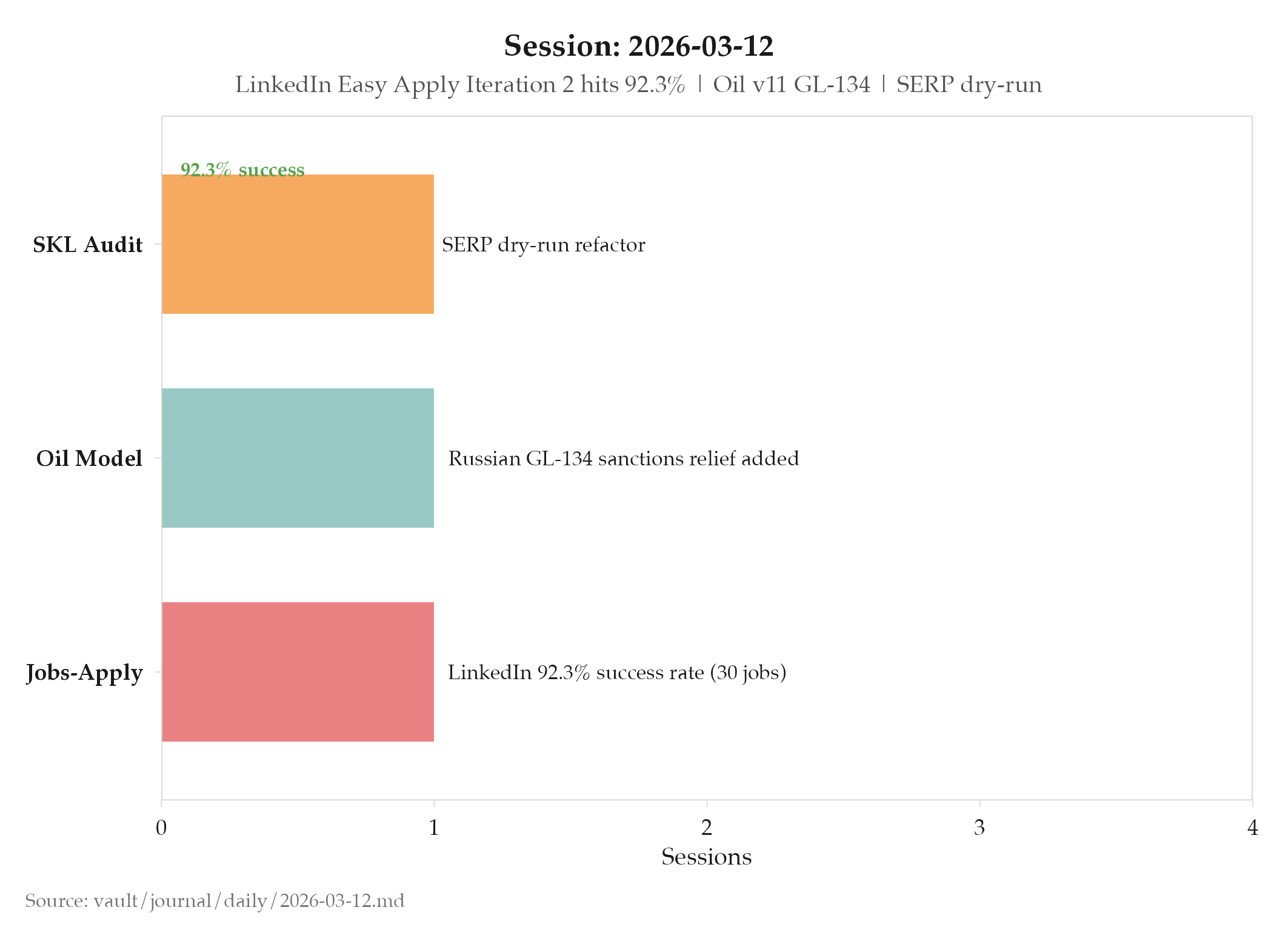
- Project: projects/jobs-apply/_index: LinkedIn Easy Apply iteration 2 achieved 92.3% effective success rate
- Fixes deployed: discard dialog (force click: 100% reliable), modal detection (Easy Apply content checks + alertdialog role), screening questions (W2/contract/C2C heuristics)
- Timing improvements: closed job detection 3s instant, similar jobs redirect instant SPA detection
- Results: 30 attempted, 15 submitted, 15 failed: 7 external apply, 6 closed, 1 fixed, 1 restart
- Gap identified: 7 external apply jobs need F21 ATS hand-off routing: architectural gap, not a tuning problem
- Project: projects/oil/_index: Russian sanctions relief GL-134 added to v11 Cycle 11+; GL-134 (30-day waiver) issued Day 12/Mar 12; Agent 4C assigned to monitor for extension
- Project: internal audit: SERP dry-run script refactored
So What (Why Should You Care)
The 92.3% success rate looks like a near-win, but the residual failures tell a more important story. Six closed jobs and seven external-apply redirects aren’t the same kind of failure: and treating them as equivalent “failures” obscures what actually needs fixing.
Closed jobs are uncontrollable environmental failures. The job was listed, the application was attempted, but the posting had already closed. The pipeline can detect these faster (3s instant detection was shipped today), but it can’t prevent them. They’re noise in the success metric, not signal about a fixable bug.
External-apply redirects are architectural gaps. The system assumed that every LinkedIn Easy Apply button leads to a LinkedIn application form. Seven jobs that day proved that assumption wrong: some Easy Apply buttons route to an external ATS (a different platform’s application system). The pipeline hit a path it wasn’t designed to handle and counted it as a failure. This is a fundamentally different category: it’s a gap in the system’s scope, not an execution failure within its scope.
This distinction matters because the remediation is completely different. For closed jobs: improve detection speed (done: 3s instant). For external-apply redirects: build a routing module that detects the redirect and hands off to the appropriate ATS handler (the F21 ATS routing identified in the open items). The architectural gap needs an architectural fix, not a tuning fix.
The GL-134 Russian sanctions relief parameters added to the projects/oil/_index model today represent the same principle at a different scale. Adding rusVol, rusLag, rusRate, and rusDur isn’t patching a bug: it’s extending the model’s scope to handle a supply factor it previously didn’t represent. Up to 128mb of Russian supply potentially flowing back into the market is a signal that a pure Hormuz disruption model would miss entirely. Scope extension in response to new real-world signals is what keeps the model from becoming stale.
What’s Next
- Design F21 ATS hand-off routing for external apply jobs
- Monitor GL-134 expiry (Apr 11) for extension: Agent 4C assigned
Log
- projects/jobs-apply/_index: LinkedIn Easy Apply iteration 2: 92.3% effective success rate
- Fixed discard dialog: force click, now 100% reliable
- Fixed modal detection: Easy Apply content checks + alertdialog role detection
- Fixed screening questions: W2/contract/C2C heuristics for compensation type questions
- Closed job detection: 3s instant; similar jobs redirect: instant SPA detection
- Results: 30 attempted, 15 submitted, 15 failed (7 external apply, 6 closed, 1 fixed, 1 restart)
- Gap identified: 7 external apply jobs need F21 ATS hand-off routing
- projects/oil/_index: Russian supply offset parameters added to v11 Cycle 11+
- GL-134 (30-day general license) issued Day 12/Mar 12
- Parameters: rusVol=60mb, rusLag=2d, rusRate=1.5mb/d, rusDur=30d
- 19mb immediately available in Asian waters, up to 128mb total offset
- Agent 4C assigned to monitor for extension/expansion
- internal audit: SERP dry-run script refactored; reviewed SERP mining history and broken URL report