Three-pillar scoring transforms audit from pass/fail to diagnostic
2026-03-10
Signal
A three-pillar scoring model with explicit weights (Correctness 35%, Completeness 25%, Richness 40%) transforms audit output from a binary pass/fail into a diagnostic that tells you which dimension to fix: and that distinction changes how you prioritize remediation.
Evidence
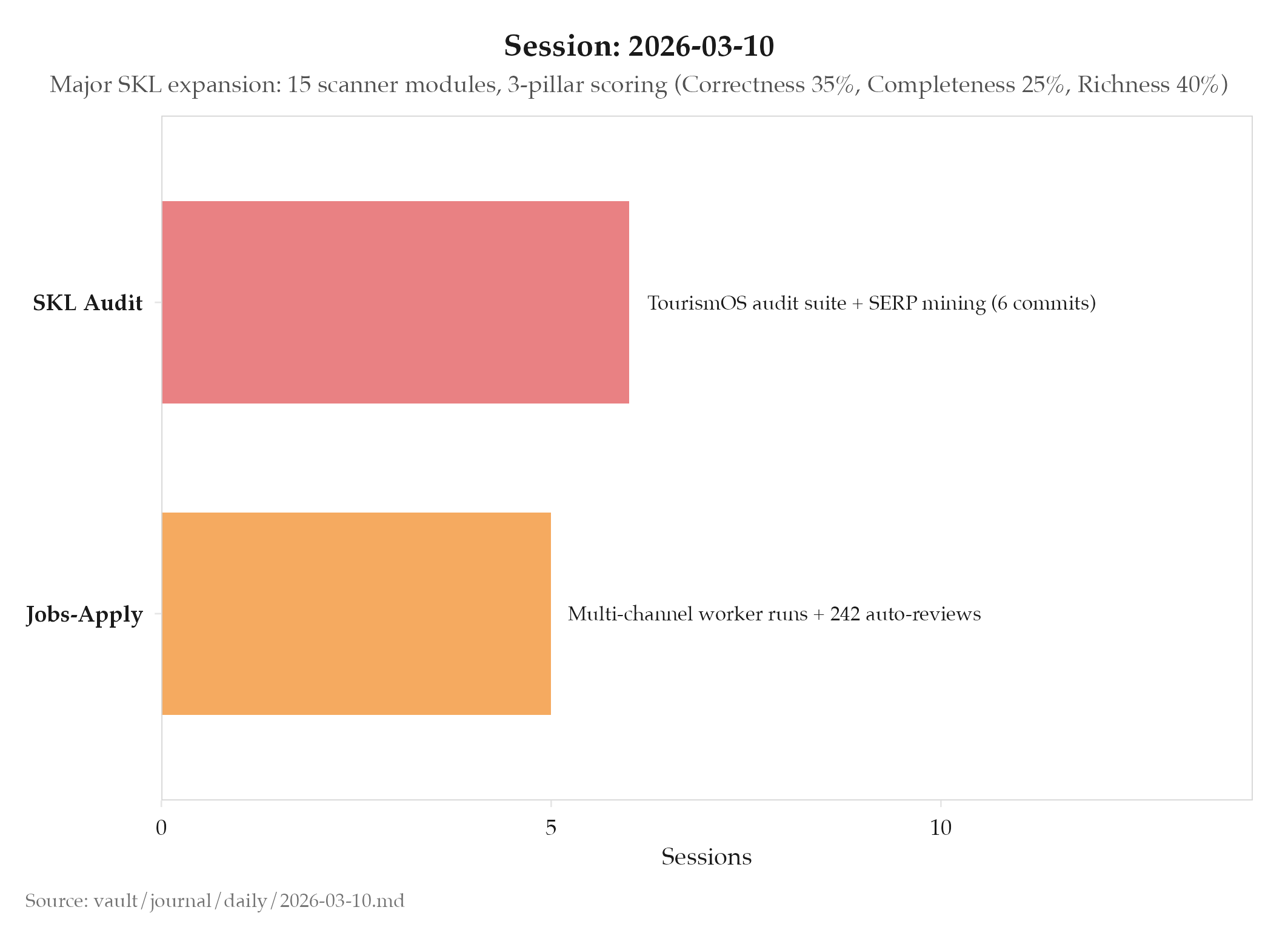
- Project: internal audit: internal-tourism-api Audit Suite shipped (6 git commits)
- Coverage: 15 scanner modules across Places, Articles, Events; structural validation, URL health (20 concurrent checks), image integrity, content quality, temporal freshness, entity-specific checks, cross-entity relational integrity
- Scoring: Three-pillar model: Correctness (35%), Completeness (25%), Richness (40%); score bands from Excellent (0.90+) to Critical (<0.40)
- New scenarios:
internal-tourism-api-place-evaluation,internal-tourism-api-article-evaluation,internal-tourism-api-event-evaluation,internal-tourism-api-full-audit(4-phase), and 4 more specialized scenarios - SERP Place Mining: new module discovering article and event URLs via SerpAPI: feeds Layer 1 (Discovery) pipeline
- Project: projects/jobs-apply/_index: 5 interactive sessions; Opus sub-agents submitted ~10 jobs per channel; 242 automated code-review sessions
So What (Why Should You Care)
Most audit systems tell you something failed. The internal audit three-pillar model tells you why it failed and which dimension is weakest. A place that scores Critical on Correctness (bad URLs, broken images) needs different remediation than one that scores Critical on Richness (thin content, no events linked to the place). These are not just different severity levels: they require completely different remediation workflows.
Correctness failures are usually technical: a URL has changed, an image CDN path is broken, a foreign key is missing. Fix them with a script. Completeness failures are usually data gaps: a place has no events, a business listing has no hours, an article doesn’t cover the location’s primary attraction. Fix them with content operations work. Richness failures are quality problems: the events exist but have no descriptions, the articles exist but are thin summaries without substance. Fix them with editorial work.
This mapping from score dimension to remediation team and workflow is the value that makes the scoring model a prioritization tool rather than just a measurement tool. Without explicit pillar weights, every audit finding looks the same and triage becomes subjective. With them, a Critical Correctness score goes to the engineering queue, a Critical Completeness score goes to the data operations queue, and a Critical Richness score goes to the editorial queue. The weights aren’t arbitrary: Correctness (35%) is weighted highest because broken data blocks all downstream use cases; Richness (40%) is weighted heavily because it determines whether users get value from the content that does exist.
The SERP Place Mining module shipped today is also worth noting separately. It answers the question “how do we discover which URLs to audit?” by using SerpAPI to find articles and events about a place that might not be in the existing data set. This is the discovery layer that feeds the quality layer: without it, the audit can only evaluate what it already knows about.
Six commits in a single day on internal audit is a strong signal about what “scope” looks like when you have a clear architecture: each commit represents a scanner module or scenario, and the work is bounded because each scanner has a single responsibility.
What’s Next
- Validate SERP Place Mining results against expected article/event discovery rates
- Begin article content alignment audit for the full 13,647 seed articles
Log
- internal audit: internal-tourism-api Audit Suite shipped: 6 commits, major expansion day
- 15 scanner modules covering structural validation, URL health (20 concurrent), image integrity, content quality, temporal freshness, entity checks, cross-entity relational integrity
- Three-pillar scoring: Correctness (35%), Completeness (25%), Richness (40%)
- Score bands: Excellent (0.90+), Good (0.75-0.89), Fair (0.60-0.74), Poor (0.40-0.59), Critical (<0.40)
- New audit scenarios shipped:
internal-tourism-api-place-evaluation,internal-tourism-api-article-evaluation,internal-tourism-api-event-evaluation,internal-tourism-api-full-audit(4-phase),internal-tourism-api-correctness,internal-tourism-api-cross-track,internal-tourism-api-portfolio,internal-tourism-api-supporting-entity-evaluation - SERP Place Mining module added: discovers article and event URLs via SerpAPI, feeds internal audit pipeline Layer 1 (Discovery) pipeline
- Report screenshots added to README; SerpAPI key removed from init.json before sharing
- Event seeding + article dedup pipeline documented
- projects/jobs-apply/_index: 5 interactive sessions: familiarized with project docs, ran Opus sub-agents for ~10 submissions per channel
- 242 automated autohunt code-review sessions