Hunt-to-Run rename forces correctness audit, finds real bugs
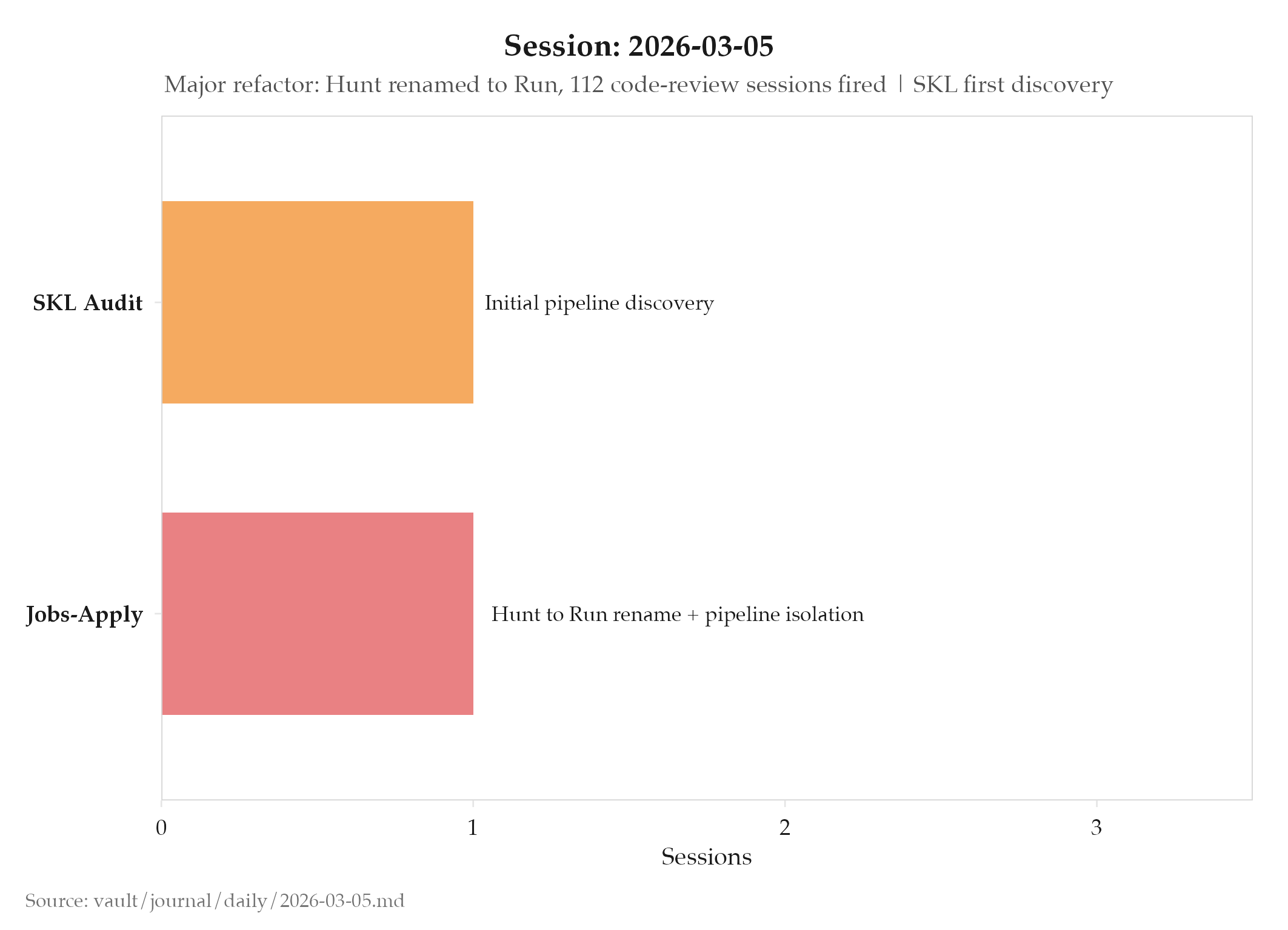
2026-03-05
Signal
A large-scale rename from “Hunt” to “Run” across 112 code-review-session-touched files wasn’t cosmetic: renaming a core abstraction forced a correctness audit on whether the implementation still matched the new mental model, and the audit found real bugs.
Evidence
- Project: projects/jobs-apply/_index: Large refactor: renamed “Hunt” to “Run” throughout the codebase
- Scale: 112 automated code-review sessions fired from the downstream changes: reflects how widely the term was used
- Bugs surfaced: Worker stats display bugs, pipeline state not isolated between concurrent runs
- Fixes deployed: Worker stats display fixed, per-worker log files added, concurrent run state isolation implemented
- Project: internal audit: First deep dive into the internal audit pipeline; reviewed quality checks for articles, places, events against internal-tourism-api
- Related: internal audit pipeline project context
So What (Why Should You Care)
Naming conventions in complex pipelines carry semantic weight that shapes how developers reason about the system. “Hunt” implied an open-ended search behavior: something that roams and discovers. “Run” implies a controlled, bounded execution: something you start, monitor, and stop. When the name changed, the expected behavior changed, and that forced the question: does the code actually behave like a “Run” or does it still behave like a “Hunt”?
In this case it didn’t: the pipeline shared state between concurrent runs, which is exactly what “Hunt” behavior would do (hunts share territory) but what “Run” behavior shouldn’t (runs are isolated executions). The rename found the bug by forcing a mental model realignment.
The 112 code-review sessions aren’t just a number: they reflect how deeply the “Hunt” concept was embedded across the codebase. Every filename, variable, and comment that used “hunt” was a potential inconsistency after the rename. Automated review caught the mechanical mismatches; the design thinking caught the behavioral ones.
If you’re maintaining complex automation systems, periodic renaming of core abstractions: even when the system is “working”: is a useful technique for discovering behavioral debt. The question “does this code do what its name implies?” catches a class of bugs that tests won’t find because the tests were written when the wrong name seemed correct.
The per-worker log files added today also represent a monitoring architecture decision. Shared logs from multiple workers produce interleaved output that’s difficult to trace when something goes wrong. Per-worker logs make each worker’s behavior independently auditable: you can look at worker 3’s log in isolation and see exactly what it did during a problematic run. This is the logging equivalent of process isolation: each worker’s story is told separately, which makes debugging parallel execution dramatically easier.
The 112 code-review sessions triggered by the rename reflect the scope of the refactor honestly. Every file that contained the word “hunt” in a meaningful context was flagged for review. Some of those reviews confirmed the rename was correct. Some caught inconsistencies. The automated review pipeline transforms a large-scope rename from a “did we catch everything?” anxiety-inducing exercise into a “every touched file was reviewed” confidence-building exercise. The sessions aren’t busywork: each one is a validation checkpoint on a specific changed file.
The internal audit first deep dive on the same day also demonstrates context-switching cost management. Rather than abandoning the jobs-apply work partway through to look at internal audit pipeline, the two projects were addressed in sequence: complete the rename refactor, then pivot to the new pipeline review. Keeping separate project contexts isolated within a single day’s work prevents partial context from one project contaminating work on another.
What’s Next
- Complete pipeline isolation validation for concurrent runs under load
- Continue internal audit pipeline review and article content alignment
Log
- projects/jobs-apply/_index: large refactor: renamed “Hunt” to “Run” throughout codebase
- Fixed worker stats display bugs surfaced by the rename
- Added per-worker log files for better observability
- Isolated pipeline state between concurrent runs: shared state was a behavioral bug the rename exposed
- 112 automated code-review sessions fired across all changed files
- internal audit: first deep dive into the audit pipeline
- Reviewed quality checks for articles, places, and events against internal-tourism-api
- Read internal audit pipeline project documentation and pipeline architecture