Production-ready automation: failure modes only surface under sustained load
2026-03-03
Signal
Making a job application engine “production-ready” is an entirely different engineering problem than making it work once: the infinite hunt design revealed that failure modes in automation only surface under sustained, multi-channel load, not in single-run testing.
Evidence
- Project: projects/jobs-apply/_index: AutoHunt infinite hunt hardening day
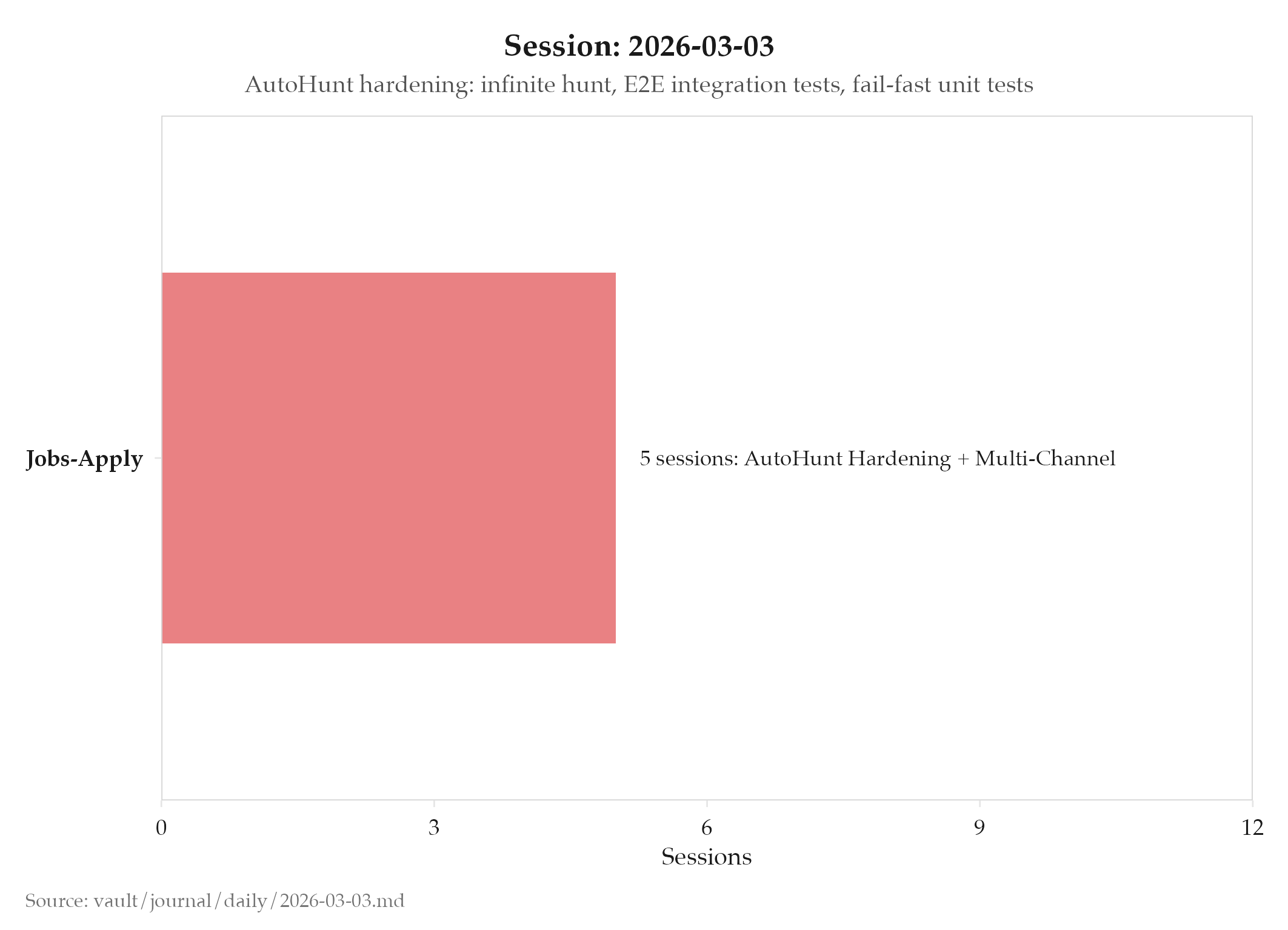
- Scope: 5 interactive sessions, multi-channel implementation plan across LinkedIn, Direct, Greenhouse
- Testing depth: 33 integration points covered in E2E integration tests; dedicated unit test suite for infinite hunt edge cases
- Core insight: Failure modes in long-running hunts are categorically different from single-run failures: the hardening audit identified these as a distinct class
- Architecture: Multi-channel design was the prerequisite for discovering channel-specific failure modes that only appear when channels run concurrently
So What (Why Should You Care)
Every automation pipeline looks reliable in a demo. The real test is whether it survives hours of continuous operation across multiple parallel channels. The infinite hunt hardening day surfaced failure modes that only appear under sustained load: things like worker state drift between channels, channel-specific rate limit handling, and queue exhaustion patterns that look fine in isolation but cascade under load.
The distinction between single-run testing and sustained-load testing is the same distinction that separates load testing from unit testing. A job that succeeds once doesn’t prove the system is reliable; it proves the happy path works. The 33 integration test points cover the failure surface of sustained operation: each one maps to a failure mode that would cause silent data loss or queue stalls during an overnight run.
If you’re building any multi-channel automation, the lesson is: design for failure before you design for features. Write the hardening audit before you scale the channel count. The infinite hunt architecture was designed with this principle from day one: the multi-channel plan included failure handling specifications alongside the feature specifications.
The fail-fast unit test suite is worth distinguishing from the E2E integration tests. Unit tests for “infinite hunt edge cases” test individual components in isolation: what happens when the queue is empty and a new job arrives? What happens when a worker crashes mid-application? What happens when a channel-specific rate limit is hit? These are edge cases that E2E tests are too slow to exercise reliably: a complete E2E test cycle might take 10 minutes and only exercises the happy path. Unit tests for edge cases run in seconds and can cover combinations that are difficult to reproduce in a full integration environment.
The 5 interactive sessions on a single architectural concern (infinite hunt hardening) reflects a level of engineering investment that distinguishes a production-ready feature from a demo-ready feature. Most demo-ready features are built in 1-2 sessions. Production-ready features require multiple sessions of hardening, edge case testing, and failure mode analysis. The session count itself is diagnostic: 5 sessions means someone took the failure modes seriously.
The multi-channel architecture (LinkedIn, Direct, Greenhouse running concurrently) also creates a monitoring requirement that single-channel doesn’t have. You need to track per-channel success rates, per-channel failure modes, and cross-channel resource usage simultaneously. Designing for multi-channel from day one means the observability infrastructure: the telemetry, the per-channel logging, the rate limit tracking: was part of the initial architecture rather than bolted on later.
What’s Next
- Multi-channel infinite hunt rollout across LinkedIn, Direct, and Greenhouse
- Validate hardening fixes under real production load over 8+ hour runs
- Monitor worker state drift patterns under concurrent channel execution
Log
- projects/jobs-apply/_index: AutoHunt infinite hunt hardening day
- Multi-channel implementation plan finalized for LinkedIn, Direct, Greenhouse
- Hardening audit completed: identified failure modes specific to long-running hunts
- E2E integration tests covering 33 integration points for full hunt cycle
- Fail-fast unit tests for infinite hunt edge cases
- 5 interactive sessions total across the AutoHunt pipeline