790 openclaw commits, a test-suite consolidation sprint at full tilt
Signal
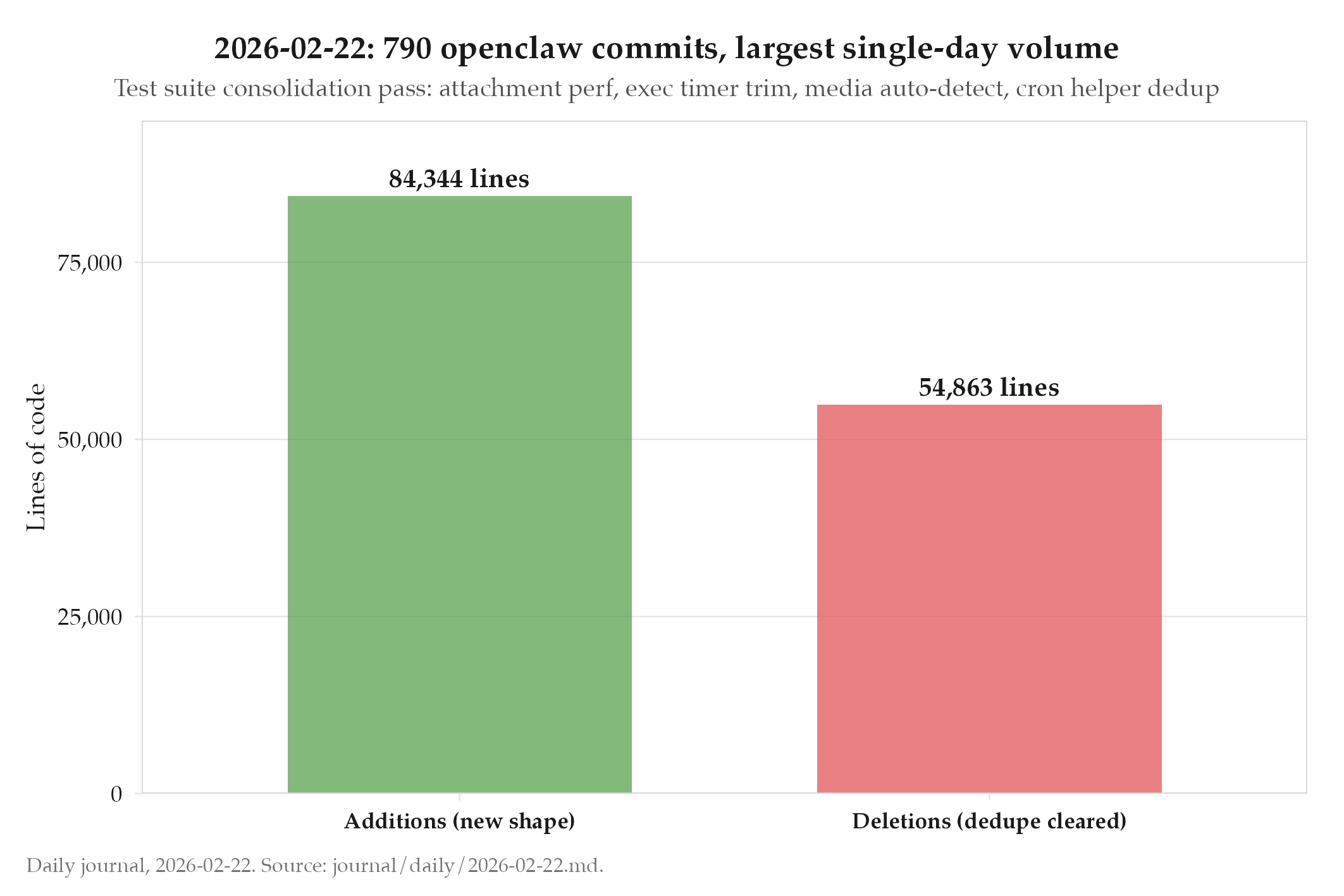
790 commits on openclaw in a single day, the largest single-day volume this repo has ever recorded. The net diff is +84,344 / -54,863, so more lines added than removed, but the top five commit messages are all test consolidation. Zero session telemetry for this window, so this is a pure git-log day. The story is visible only through the commit graph.
Evidence
openclaw (790 commits, +84,344 / -54,863): the entire day was a test suite consolidation pass. Redundant suites got folded together, attachment tests sped up, exec timer test runtime shrank, media auto-detect coverage merged into one suite, and isolated agent cron test helpers were deduplicated across files. Five of the top commit messages start with test: and one with refactor(test):. The commit cadence implies heavy use of automation: a human cannot type 790 purposeful commits in a single day without tooling, so this is a batch-mode cleanup run where each commit represents a single test refactor landing atomically.
The 54,863 lines deleted matter more than the 84,344 added. Deleting that much test scaffolding while keeping coverage green is a leverage move. Timer-based tests shrinking is the tell: those are the suites that flake in CI and cost the most wall-clock per run. When they shrink, the whole pipeline speeds up.
So What
This is what a test suite audit looks like from the outside. The goal of this kind of sprint is not new functionality; it is freeing up CI budget and reducing the noise floor so real regressions stand out. When a test suite grows organically over years, you end up with three suites that cover the same code path, each flaking in their own way. A day like this rolls them into one canonical suite per area, deletes the deadweight, and leaves a repo that runs faster and fails more legibly.
The lack of session telemetry also tells a story. Zero bloomnet sessions means the work happened outside the normal Claude Code capture window, either in a different tool, in batch scripts, or in a mode that does not register. That is fine for a test-cleanup day but a gap worth closing if I want full provenance.
What’s Next
Does the CI p99 drop visibly tomorrow, or did 790 commits just redistribute the same runtime? The real test of a consolidation sprint is whether the next full pipeline run finishes measurably faster. If it does not, the dedup was cosmetic and the timer tests still dominate wall-clock. If it does, the next move is to aim the same treatment at the next slowest suite and keep ratcheting down.
I also want to close the telemetry gap. When a whole day of real work does not show up in bloomnet, the dashboard is silently wrong about throughput. That is the kind of blind spot that compounds into bad capacity decisions weeks later. Right now the absence of a day on the dashboard is ambiguous: it could mean I rested, or it could mean I did the most work of the month. Those two cases should never look the same in a metrics system I trust.
The broader pattern worth naming: large git-log days without session telemetry are probably under-credited in any retrospective. If I ever tune the journaling pipeline based purely on session counts, days like this get treated as holidays, which is wrong. The fix is to weight commits as a fallback signal when sessions are absent, and to flag divergence between the two streams as its own alert.
Log
- Sessions: 0 (bloomnet.db lag, evidence from live git)
- Top repos: openclaw (790)
- Commits: 790 across 1 repo (+84,344 / -54,863)
- Notable: test suite dedupe, attachment perf, exec timer trim, media auto-detect merge
- Cost: not tracked (pre-bloomnet-ingest window)