Community PR absorption: 315 commits, many external authors
Signal
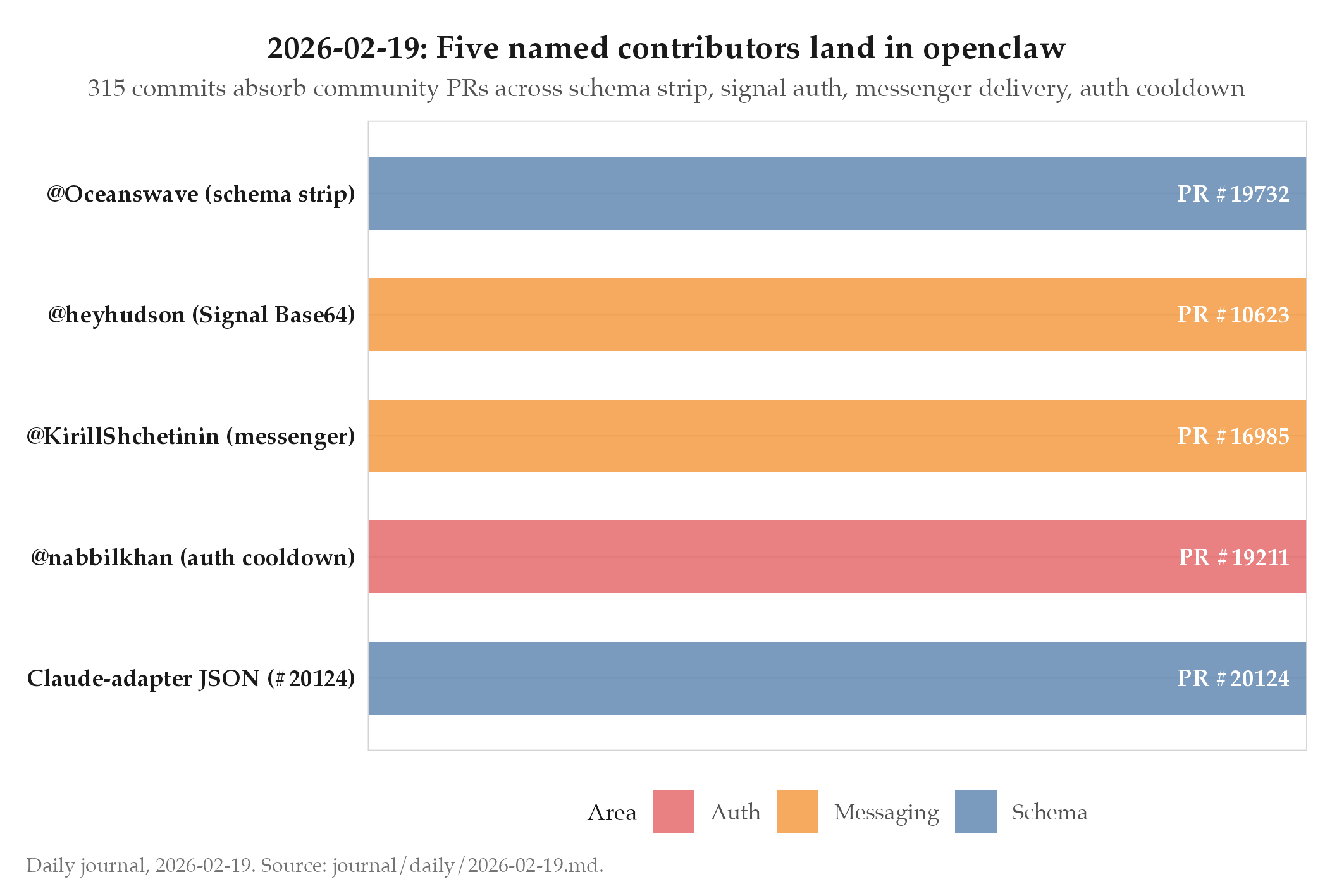
315 openclaw commits today, many with external author credit in the message trailer Schema-fix for google-antigravity stripped unknown JSON Schema keywords, credit @Oceanswave (PR 19732) Signal group Base64 IDs now preserve case in target normalization, credit @heyhudson (PR 10623)
Evidence
openclaw (315 commits, +34,159/-17,187): community PR absorption across auth, messaging, and schema. The author credit on today’s merges reads like a real community day: multiple external contributors, each one landing their own PR, each one named in the trailer.
Cloud Code Assist JSON Schema strip: Claude-specific adapter got hardened (PR 20124). Default messenger delivery target feature landed (PR 16985, thanks @KirillShchetinin). Auth profile cooldown clears all usage stats fields now (PR 19211, thanks @nabbilkhan). The cooldown clear is the kind of fix that only matters when you hit it, and when you hit it, it matters a lot: partial clears were leaving stats fields populated across a cooldown boundary, which produced misleading “still on cooldown” reads.
Signal Base64 ID case preservation is the most specific of today’s fixes. Base64 is case-sensitive, and any normalization step that touches case will silently break group ID matching. Preserving case at the normalization layer means the IDs round-trip cleanly, and the bug does not recur in any other Base64 context downstream.
Net ledger: 16,972 additions. The in-tree fix rate stayed above the delete rate, which says community PRs are net-positive on surface area. That’s the shape I expect from absorption days: real features and real fixes, both of which add code.
No session telemetry today, so this reads off git alone. That’s the third day this week running on git-only evidence.
So What
Five named contributors in the top-5 commit messages is the shape of a healthy OSS week. The community is actually shipping, not just filing, and the PRs are landing with real attribution. That is a maintainer-volume signal worth naming: when the named-contributor count on a single day approaches the in-house committer count, the project is working.
The schema-strip pattern keeps showing up. That means I still have provider-adapter leaks that need a codegen boundary. Every time a provider sends a schema with unknown keywords, I have to strip them at the adapter layer, and every strip is a line of code that would not exist if the adapter were generated from a canonical schema. The right long-term move is to generate the strip logic once and reuse it.
This is maintainer-volume work, not greenfield, and worth naming as such.
What’s Next
With 5 external PRs merged on a single day, what is the review-latency tail for open PRs still sitting in the queue? I want to pull the review latency distribution for the last thirty days and look at the tail specifically. Median latency is fine; the tail is where contributors give up. If there’s a PR at the 95th percentile sitting for more than a week, I want to know before the author loses interest.
Second: the schema-strip pattern is officially a class, not a one-off. I want to scope a codegen boundary for provider adapters and land the first one next week so the pattern stops surfacing as separate PRs.
Third: the default messenger delivery target feature deserves a documentation pass. Features that land from external contributors are load-bearing for downstream users, but they often ship without the configuration example and the failure-mode guidance that would make them safe to adopt by default. A five-minute documentation pass while the PR is still fresh is strictly cheaper than answering the same three questions in issues over the next month.
Log
- Sessions: 0 (evidence from live git)
- Top repos: openclaw (315)
- Commits: 315 across 1 repo (+34,159 / -17,187)
- Notable: community PR absorption (5+ external contributors), schema-strip fixes, auth cleanup
- Cost: not tracked (no bloomnet.db session coverage)