855 commits, 102K additions: openclaw deduplication and CI repair
Signal
855 commits in a single session, 13 minutes, $0.07. This is batch merge activity at scale, not interactive development.
Evidence
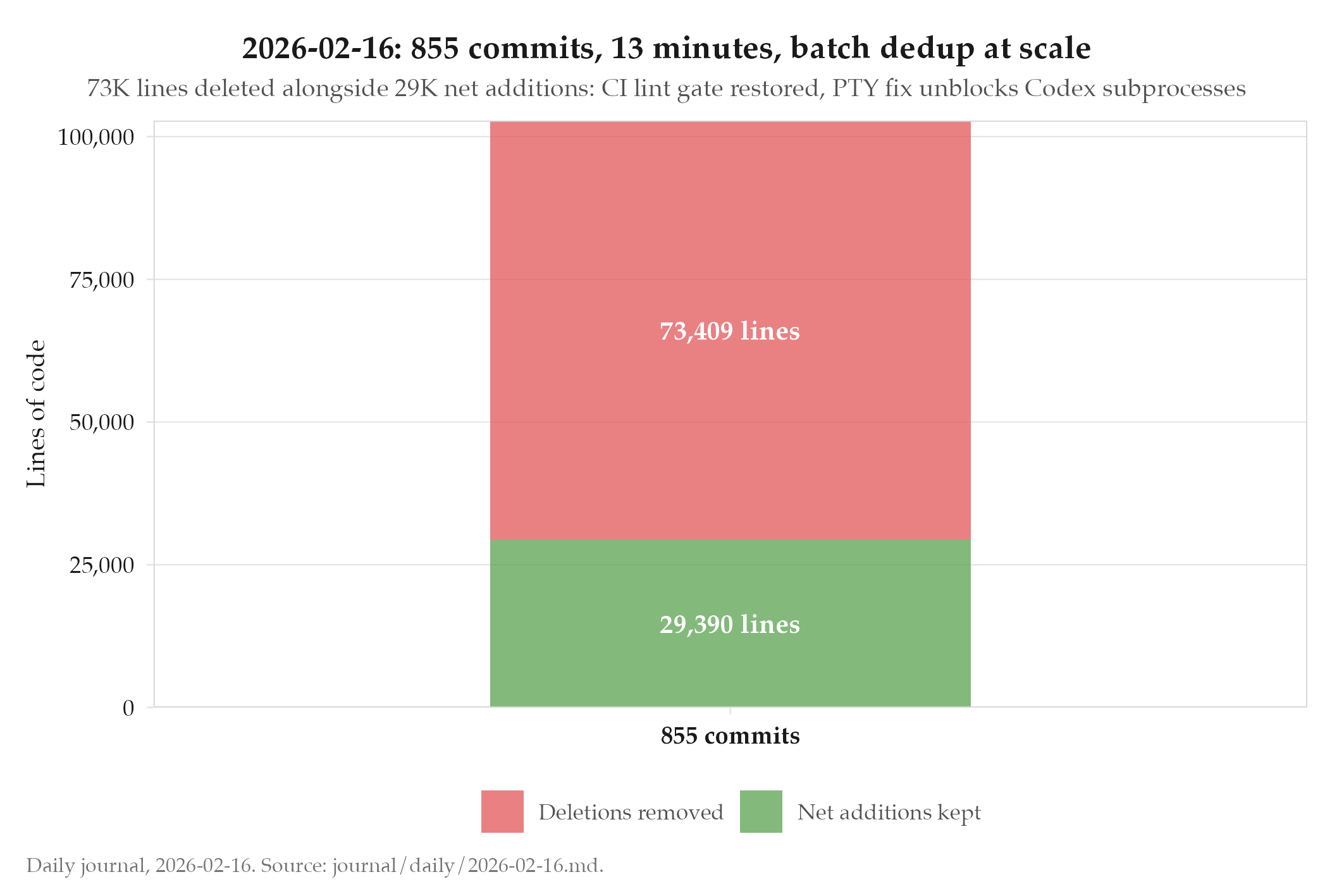
openclaw absorbed 102,799 additions and 73,409 deletions across 855 commits. The commit message pattern is “dedupe” across every subsystem: core shared config and runtime helpers, channels transport and gateway test scaffolds, harness and command workflows, extensions connector helper usage. Every one of those is its own copy of the same logic that had drifted independently, and every one of them just got collapsed to a single source.
A PTY process spawning refactor fixed Codex and similar processes dying on PTY via #14257. That one had been a silent failure mode for external subprocess workflows: the process would start, the PTY would get attached, and then the whole thing would die without a clear signal to the caller. Fixing it unblocks everyone using a Codex-style subprocess, not just the one case that reported it.
export-html templates got bundled instead of read from node_modules, eliminating a brittle filesystem dependency. That’s the kind of fix that only matters on the one machine where node_modules layout differs, but on that machine it is total. The main lint and typecheck jobs were restored in CI after direct merges had broken them. Accidental a2ui bundle artifacts got cleaned from the tree. 1 session, 13 minutes, $0.07.
That cost is worth naming. Thirteen minutes of tracked session time absorbed 855 commits. That’s batch merge shape, not interactive work. The commits were authored earlier and the session was the merge-and-release step.
So What
Deduplication at this scale is structural debt reduction. Every “dedupe” commit removes a copy that would otherwise drift independently, and the cost of drift is always paid later at the worst possible time. The CI restore after direct merges is the operationally critical fix; a broken lint gate silently degrades code quality on every subsequent merge until someone notices. The window between “gate broken” and “someone notices” is where regressions land, and the window had been open long enough to be worth marking.
The PTY fix unblocks Codex-style subprocess workflows that were silently dying. That is the kind of fix I want to retell because the failure mode (silent process death) is a class of bug, not a one-off. Anywhere else in the codebase where a subprocess can die without signaling the parent is worth auditing with the same lens.
What’s Next
102K additions in a single batch with no session context makes the net effect hard to audit. Which of these deduplications introduced regressions that the restored CI will now catch? I want to watch the first post-merge CI run closely: a newly restored lint gate is the most likely to surface a backlog of quietly accumulated violations.
Second: I want the dedupe work to land with a test that asserts “only one copy of this helper exists.” That’s the kind of invariant that’s easy to regress into if the split gets recreated by a well-meaning PR.
Third: the export-html bundling change should get a smoke test that actually renders a template from the bundled source, not just checks that the bundle exists. Bundled assets have a bad history of looking correct in the artifact and failing at load time because of a path mismatch or a missing sub-asset. The cheapest insurance is a render-on-startup check in the test harness: if the bundled template cannot produce a minimal output, fail loud. That turns a brittle filesystem dependency removal into a structurally stable dependency removal.
Log
- Sessions: 1 across 1 projects, 13m total
- Top projects: misc (Documents) 13m
- Commits: 855 across 1 repos (102799 +, 73409 -)
- Top repo: openclaw
- Cost: $0.07