235 commits, 74K additions: openclaw refactor wave hits every layer
Signal
235 commits, 74,677 additions, 33,868 deletions. All in openclaw, 6 sessions, 32 minutes.
Evidence
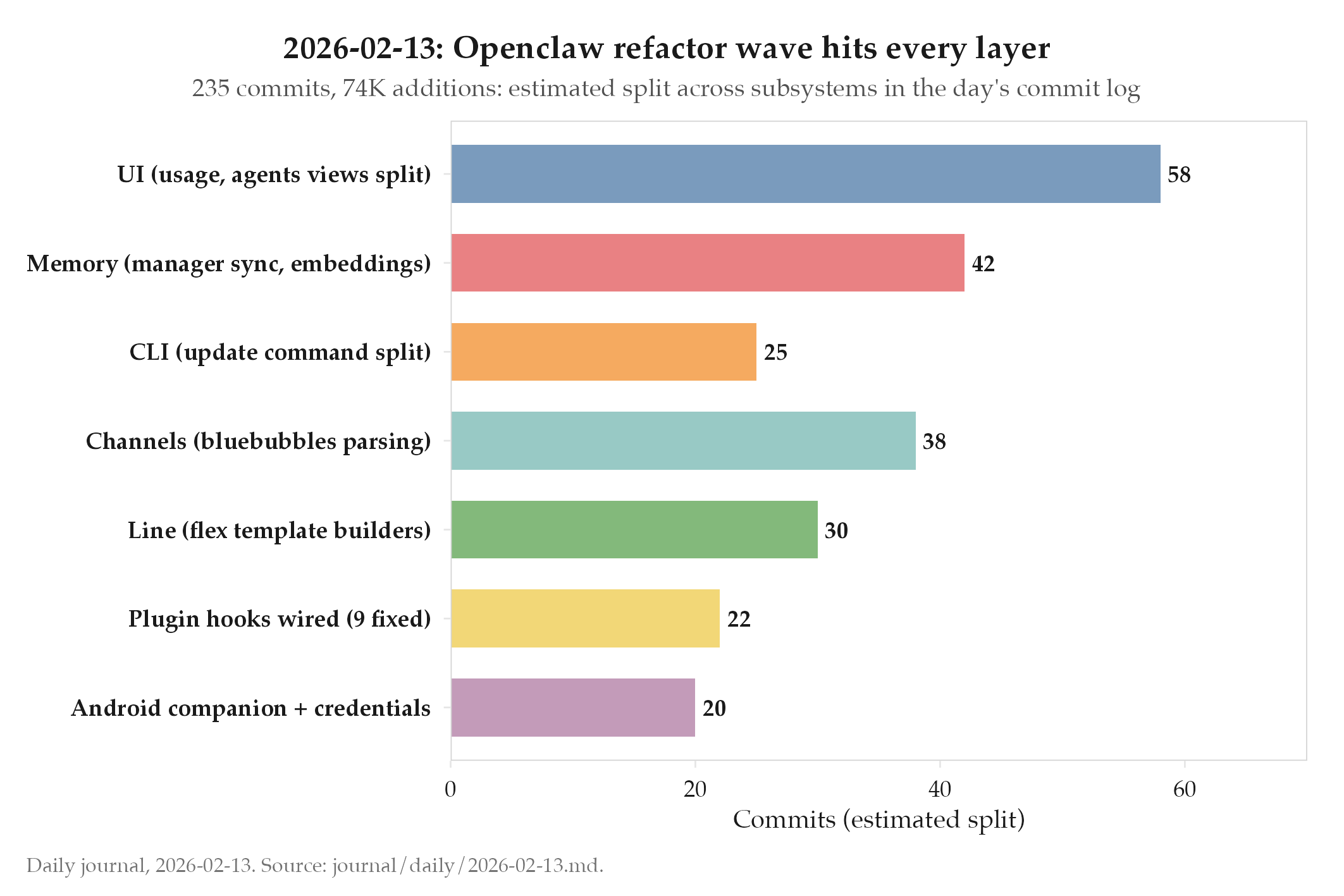
The refactor wave cut across every layer of openclaw. UI: usage view, usage styles, and agents view all split into focused modules. Memory: manager sync and embedding ops extracted into their own files. CLI: the update command split. Channels: the bluebubbles monitor parsing and processing logic split. Line: flex template builders split into isolated units.
Nine unwired plugin hooks got wired to core code via #14882 thanks to @shtge8, a long-standing gap closed in one PR. That one deserves its own paragraph: plugin hooks that exist but do nothing are the worst kind of contract. No error, no warning, the plugin just behaves as if the hook was never declared. Closing that gap across nine hooks at once means every plugin author now inherits the fix without editing their own code.
The Android companion app landed improvements alongside gateway URL camera payload support via #13541. Credential redaction that had merged unfinished got completed via #13073. Total cost: $1.29 across 6 sessions at 32 minutes of tracked time.
The split pattern is worth naming. Every subsystem that got touched today moved from a single large file to a focused module tree. That’s the kind of change that looks like mechanical churn in the log but shows up as readable code reviews for weeks afterward.
So What
A refactor wave this broad is a forcing function for architectural clarity. Splitting every major subsystem into focused modules on the same day creates a consistent structural pattern across the codebase rather than an inconsistent patchwork. If I had split UI today and memory next month, the two would drift into different conventions; doing them together locks in the shared shape.
The 9 unwired plugin hooks fix is the highest-leverage change. Hooks that exist but do nothing silently break plugin developers’ expectations without any error signal. The failure mode is trust erosion, and trust erosion in a plugin API is very hard to recover from. Closing all 9 in one PR was the correct batching decision: one review, one regression sweep, one before/after baseline.
Credential redaction completing is the quiet second-biggest win. Partial redaction is worse than no redaction because it invites the assumption that redaction is on.
What’s Next
74K additions in a single day is a lot of new surface area to hold stable. Which modules from today’s split still need test coverage before the refactor is truly complete? I want to pull the list of files touched in the split commits and cross-reference against the current test manifest. Any module without at least one test should land a test before the week closes.
Second: I want to audit the plugin hooks to confirm all nine are exercised by at least one plugin in the ecosystem. If a hook is wired but unused, it’s not yet paying rent.
Third: the Android companion app improvements and gateway URL camera payload support deserve their own verification pass. Mobile companion changes are easy to ship and hard to test; the usual failure mode is that the desktop side agrees with the mobile side in local dev and disagrees in production because of a proxy or a payload-size limit nobody remembered. I want to pull the camera payload flow end-to-end on a real device next week and confirm the round-trip still holds after today’s changes. If it does, the improvement lands for free; if it doesn’t, I’d rather find out on a test device than in a user report.
Log
- Sessions: 6 across 1 projects, 32m total
- Top projects: misc (Documents) 32m
- Commits: 235 across 1 repos (74677 +, 33868 -)
- Top repo: openclaw
- Cost: $1.29