127 commits, 2 repos: openclaw deps churn and CLI hardening
Signal
127 commits across 6 sessions, $1.46 spent. openclaw dominated at 126 commits; brandhouse_ppt picked up 1 stray commit.
Evidence
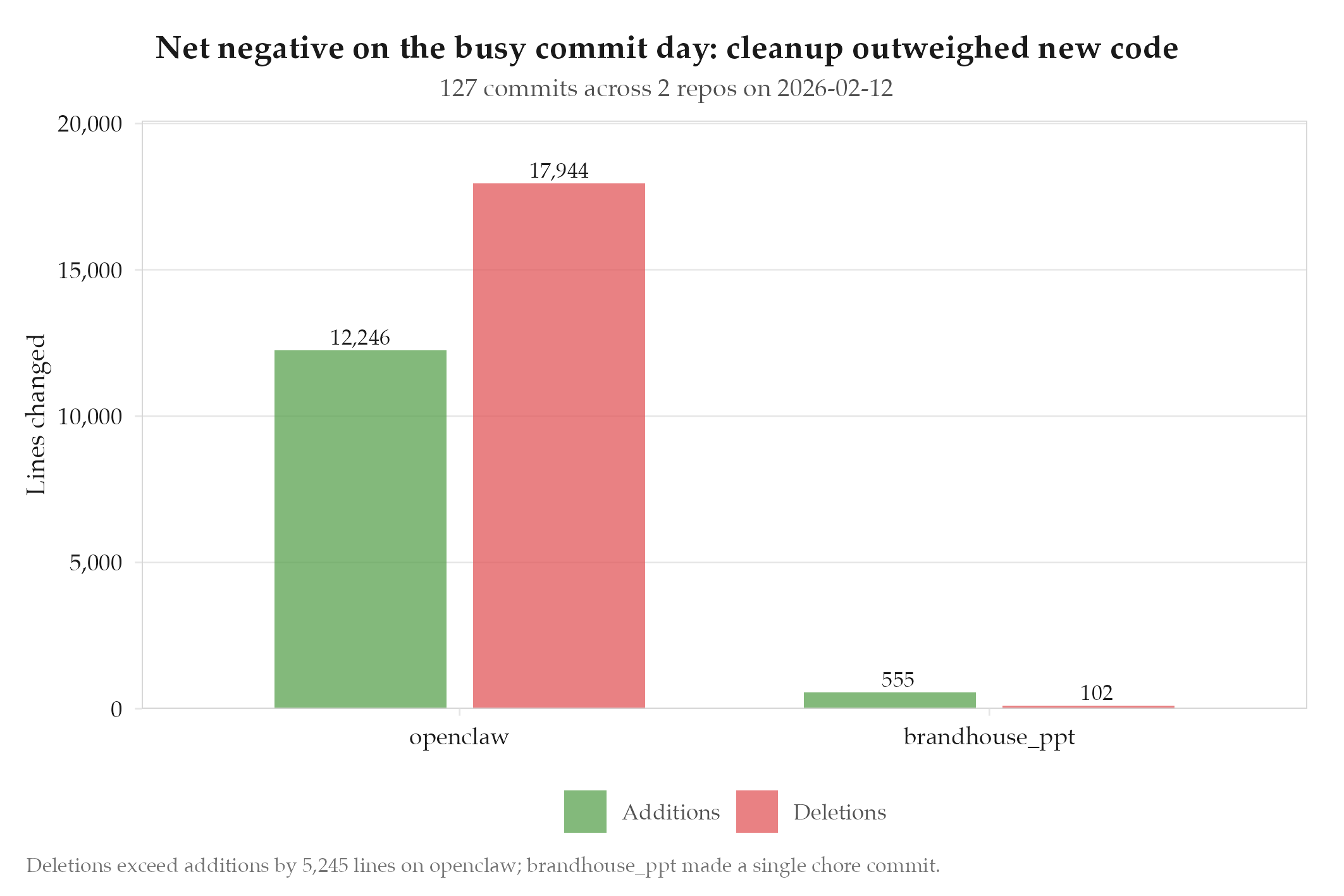
openclaw saw 12,246 additions and 17,944 deletions: net negative, which means cleanup outweighed new code. The Z.AI provider endpoint plus model catalog landed via #13456, extending the provider surface beyond the incumbent set. totalTokens compaction tracking got fixed via #15018, correcting a silent token accounting bug after compaction runs. That one was eating cost visibility at the exact moment I need the visibility most: after a long-running session has trimmed its own context.
CLI input handling was enhanced with better documentation. The issue labeler got state tracking and PR support, which closes a loop I’ve been leaving open for weeks. A schema.ts refactor restored the use of schema.hints after an accidental regression. brandhouse_ppt took 555 additions and 102 deletions in a single chore commit. Total across 6 sessions: 46 minutes, 2 repos.
Notable shape of the day: net-negative on the dominant repo, every fix pointed at an accounting or UX surface rather than a new feature. The sessions were short, which matches the commit density: a lot of small, targeted landings instead of one long-running build.
So What
Net-negative diffs on a busy commit day mean the codebase got smaller and more correct. The totalTokens fix after compaction is the sharpest find here: silent accounting errors in token usage create invisible cost drift that compounds across long-running agents. I don’t want to look back at a 20k-token misreport two weeks from now and have no idea where the drift started. Fixing it upstream at the compaction callsite is the right move because every downstream consumer (usage view, billing, cost alerts) inherits the corrected number for free.
The Z.AI provider landing on the same day as dependency churn is a reminder that provider-adapter work is never just “one endpoint and a model string.” There’s always a downstream consumer expecting a particular shape, and the provider catalog has to carry its weight in the UI.
What’s Next
The Z.AI provider landing alongside dependency updates suggests openclaw is actively expanding its provider surface. How many external providers are now wired, and which ones are still stub-only? I want a single table: provider name, endpoint status, model catalog completeness, last integration test green. That table doesn’t exist yet, and the day I need to triage a provider regression is exactly when I’ll regret not having it.
Shorter-term: I want to verify the compaction tracking fix by pulling a pre-fix and post-fix session and diffing the reported totals against the raw token counts. If the numbers match, I close the thread; if they drift, I reopen.
Third: the issue labeler state tracking and PR support land is a quiet enabler I want to exercise on the next real triage pass. Labeler improvements only prove themselves on live issues, not on the release notes, and I have a backlog of untriaged issues sitting in openclaw that would be a fair test. If the labeler closes the triage gap without me hand-labeling, it’s earned its place in the default workflow. If it misses on the first pass, I want the miss to inform the next round of label rules rather than silently rolling back. The schema.ts regression restore is worth a callout for a different reason: accidental regressions on schema files are the class of bug that surface weeks later as unexplained downstream failures, so restoring schema.hints usage before it compounds is a real-time win even if the changelog reads as maintenance.
Log
- Sessions: 6 across 1 projects, 46m total
- Top projects: misc (Documents) 46m
- Commits: 127 across 2 repos (12801 +, 18046 -)
- Top repo: openclaw (126 commits)
- Cost: $1.46