58 openclaw commits in 21 minutes: docs and stability hardening
Signal
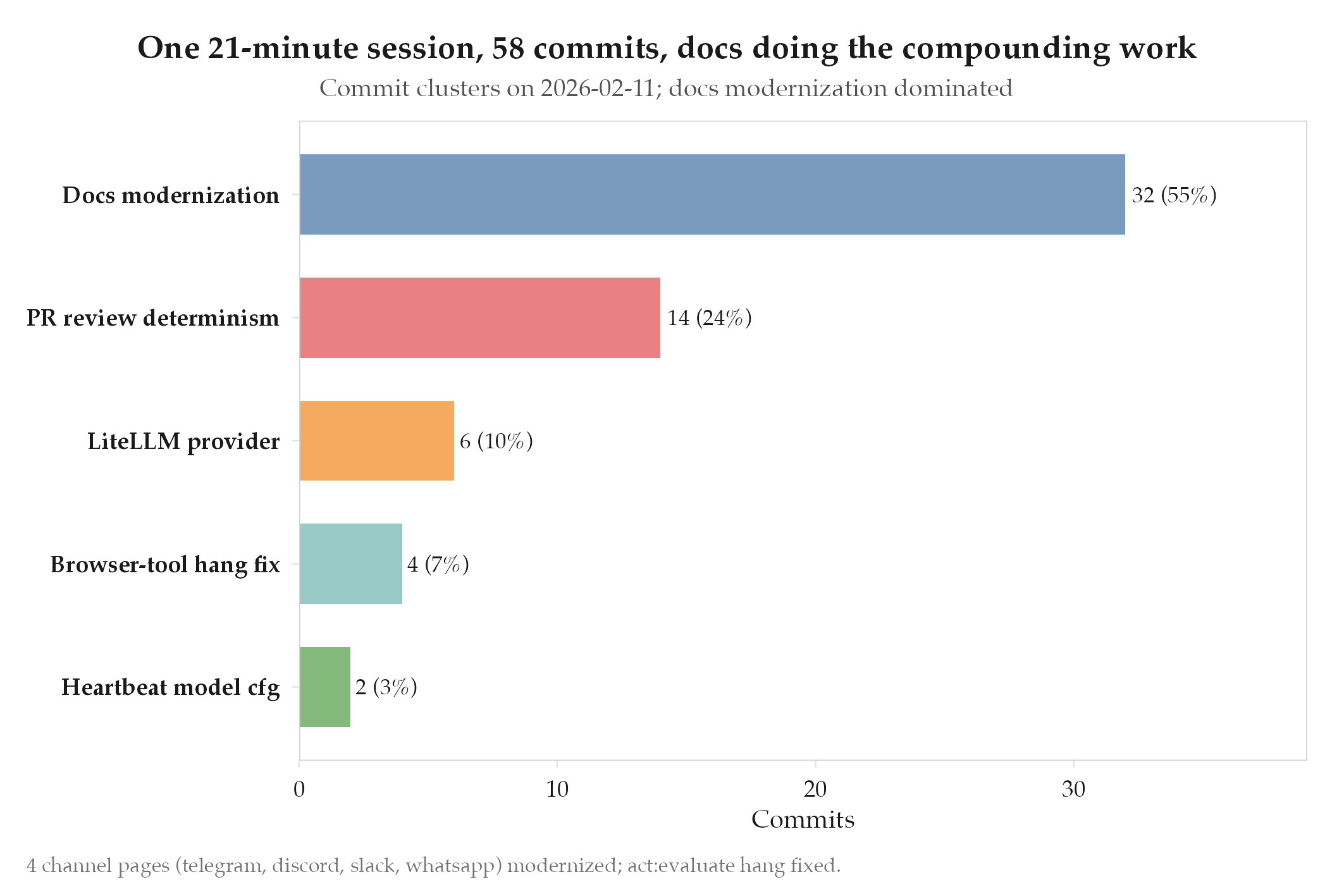
One session, 21 minutes, 58 commits to openclaw. The ratio is diagnostic: 58 commits in 21 minutes is bulk PR review work clearing its queue, not active feature development. Naming the shape of the day matters because the optics and the reality are different.
Evidence
openclaw took 58 commits totaling 11,728 additions and 6,443 deletions across the single session. Commit messages cluster around docs modernization: gateway, telegram, discord, slack, and whatsapp pages all got updated in the same batch. Four channel-specific doc pages moving at once is not coincidence; it is the signature of a documentation pass that touched a shared template or set of conventions across the channel section.
The PR review tooling got a determinism fix with the commit titled “making PR review chores deterministic + less token hungry.” Determinism in a review tool is the difference between a tool I can trust to produce the same verdict on the same diff twice and a tool that negotiates with itself. The token reduction is a secondary win; less expensive reviews are better reviews when the cost would otherwise dissuade using the tool on smaller PRs.
act
had a browser-tool hang bug fixed via #13498. A hung browser tool in an eval pipeline is the worst kind of bug: the eval does not complete, does not cleanly fail, and consumes resources until something times it out at a much higher level. The fix removes a failure mode that was silently costing more than it looked like it was costing.A LiteLLM provider landed via #12823, extending the provider matrix. The heartbeat model config got hardened to honor the heartbeat.model setting for heartbeat turns, which closes a config-honoring gap where the heartbeat was using the default model regardless of user preference.
Total cost was $0.18 across the single session, which is tiny relative to the commit count. The math again points to small targeted commits rather than AI-assisted rewrites.
So What
Docs modernization is infrastructure work: it compounds invisibly. The 4 channel-specific pages (telegram, discord, slack, whatsapp) getting modernized in a single pass keeps knowledge debt from accumulating across the codebase. Knowledge debt is the kind of debt that feels small at every point in time and gets crushing in aggregate; pages that drift out of step with the code train users to stop trusting the docs, and that loss of trust is very expensive to recover.
The act
hang fix is the more operationally important change of the day. A stuck browser tool in an eval pipeline costs far more than the fix, because eval pipelines tend to be long-running and the cost of a hang is cumulative until the hang is detected. Fixing the hang at the source rather than adding a timeout around it means the eval system’s behavior becomes predictable rather than bounded.The PR review determinism work is the piece I want to watch most carefully. Determinism in a reviewer makes it auditable; non-determinism makes every disagreement a coin toss. Pair that with the token reduction and the tool starts to be something that can run on every PR rather than every big PR.
What’s Next
The PR review determinism work suggests the review tooling is getting production-hardened. What does “less token hungry” actually buy at scale across large openclaw PR queues? The concrete measurement I want is the cost-per-review curve against PR size. If the new version of the tool scales sublinearly with PR size where the old version scaled linearly, that is a real architectural win. If the reduction is a flat percentage, it is a nice savings but not a structural shift.
On the heartbeat config change, the remaining question is whether any other sites in the codebase still use the default model for heartbeat-like operations. Fixing the heartbeat specifically is valuable; fixing only the heartbeat while leaving sibling code paths with the same bug is the kind of partial fix that trains a false sense of completion.
Log
- Sessions: 1 across 1 projects, 21m total
- Top projects: misc (Documents) 21m
- Commits: 58 across 1 repos (11728 +, 6443 -)
- Top repo: openclaw
- Cost: $0.18