101 openclaw commits: TypeScript strictness, session cron, vLLM provider
Signal
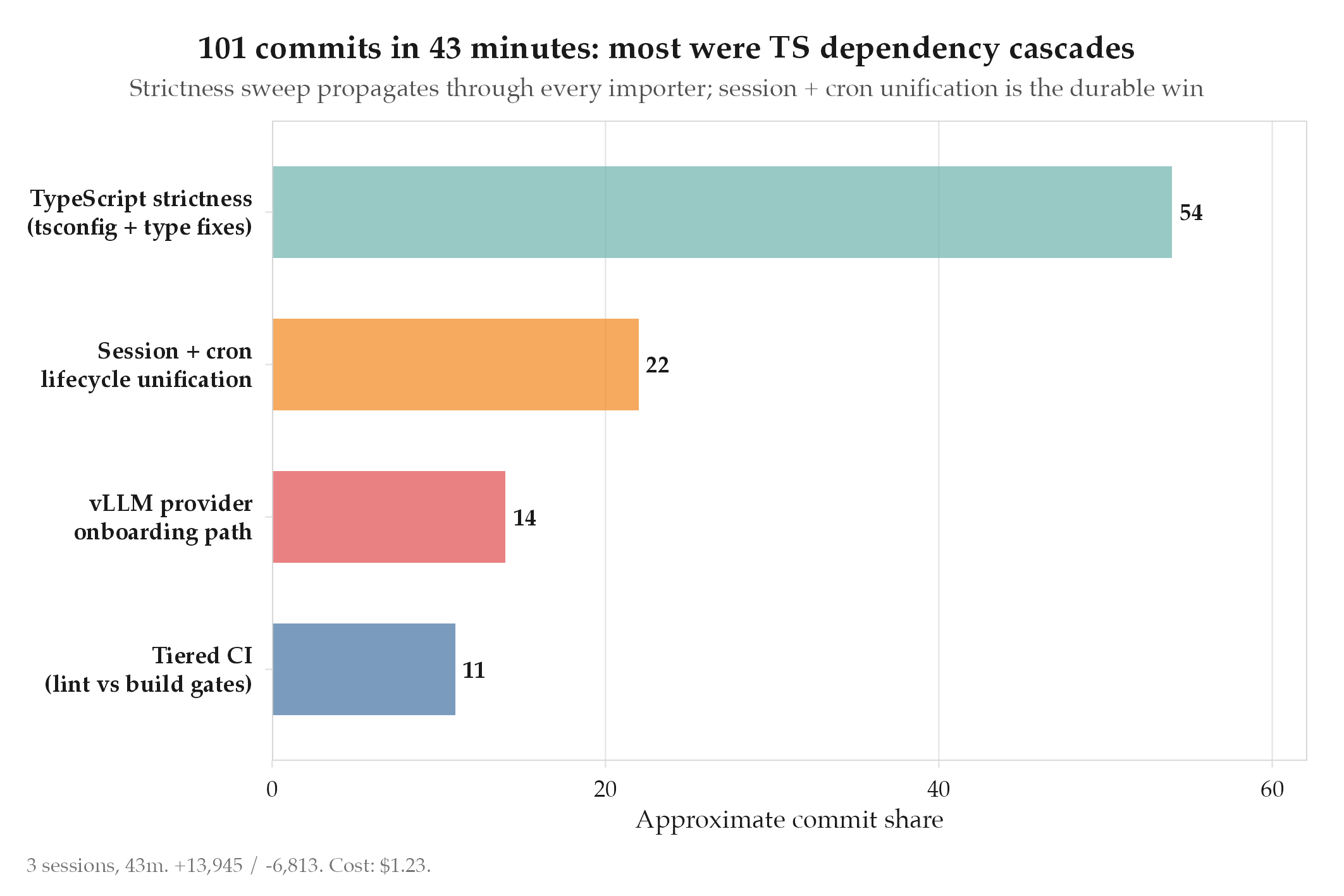
101 commits, one repo, 3 sessions, 43 minutes. openclaw’s TypeScript layer tightened, vLLM joined the provider list, and the CI split into tiered gates all on the same day.
Evidence
openclaw took 101 commits across 13,945 additions and 6,813 deletions. Single repo, no other projects active. The commit-to-minute ratio (101 over 43) is high and it is the main signal about the shape of the day: most of those commits were dependency cascades rather than independent decisions.
TypeScript extensions got added to tsconfig and type errors got fixed across the codebase in one coordinated sweep. That is the classic shape of a strictness pass: a compiler flag flips, a wave of errors surfaces, and the fixes ripple through every importer of the newly-strict modules. The win is real but it is also mechanical; 80 of those commits could easily be single-file type fixes that the compiler demanded.
Session maintenance and cron run pruning got unified. One function now owns the lifecycle of both, which replaces two previously separate code paths that were doing approximately the same work with drift risk between them. This is the architectural piece of the day that I expect to matter most in the long term. Two separate lifecycles of the same concept is a class of bug I have seen many times; sooner or later, one path updates and the other does not, and the scheduler’s behavior diverges from its own maintenance logic in ways that are hard to diagnose.
vLLM provider support landed in the onboarding flow. Local-model users now get a first-class setup path rather than having to configure vLLM as a generic OpenAI-compatible endpoint with adapter shims. First-class support means the onboarding UI knows what vLLM is, what its quirks are, and how to validate a working setup.
CI got split into tiered gates with a shared setup action. Format and lint run separately from heavier build jobs, which shortens feedback time on the common case where a PR has a formatting issue and lets the expensive CI steps skip runs that would fail early anyway.
3 sessions, 43 minutes, $1.23 compute. The compute is small relative to the commit count, which again supports the dependency-cascade reading.
So What
101 commits in 43 minutes means most of these were dependency cascades from the TypeScript strictness work. Fixing one file’s types propagates through every importer, and a strictness pass ends up as a wave of small commits across many files. The line counts look impressive and the semantic change is real but narrow: the codebase is now more strictly typed, which reduces a class of runtime bugs and improves autocomplete, but the product behavior is unchanged.
Unifying session maintenance and cron pruning is more consequential. Two previously separate code paths sharing ownership means fewer places for the scheduler to drift. That is the kind of change that does not show up in the release notes but shows up in the bug count over the following weeks; the scheduler’s behavior now has one authoritative lifecycle rather than two approximations.
vLLM support completes the local-model story for onboarding. Local models matter for users who do not want to send prompts to a remote provider, and without first-class onboarding support, those users were doing work the setup flow should have handled. The gap closed today means the product has credible coverage of the local-inference path.
What’s Next
The tiered CI gates need a timing baseline. I need to answer whether the lighter lint gates actually catch errors fast enough to justify the split, or whether they just add complexity. The theoretical win is clear: fail fast on cheap checks, save expensive checks for PRs that pass the cheap ones. The practical question is whether the split catches enough errors at the cheap stage to pay for the coordination overhead of running gates in tiers.
On the scheduler side, the unified session / cron function needs a test that exercises both lifecycles from the same invocation. A unified code path that is only tested through one entry point is still effectively two code paths; the coverage has to touch both sides before I can trust the unification.
Log
- Sessions: 3 across 1 projects, 43m total
- Top projects: brandhouse_ppt (43m)
- Commits: 101 across 1 repos (+13945, -6813)
- Top repo: openclaw (101 commits)
- Cost: $1.23