URI-based batch pipeline lands; 56 commits across 3 repos in 8 minutes
Signal
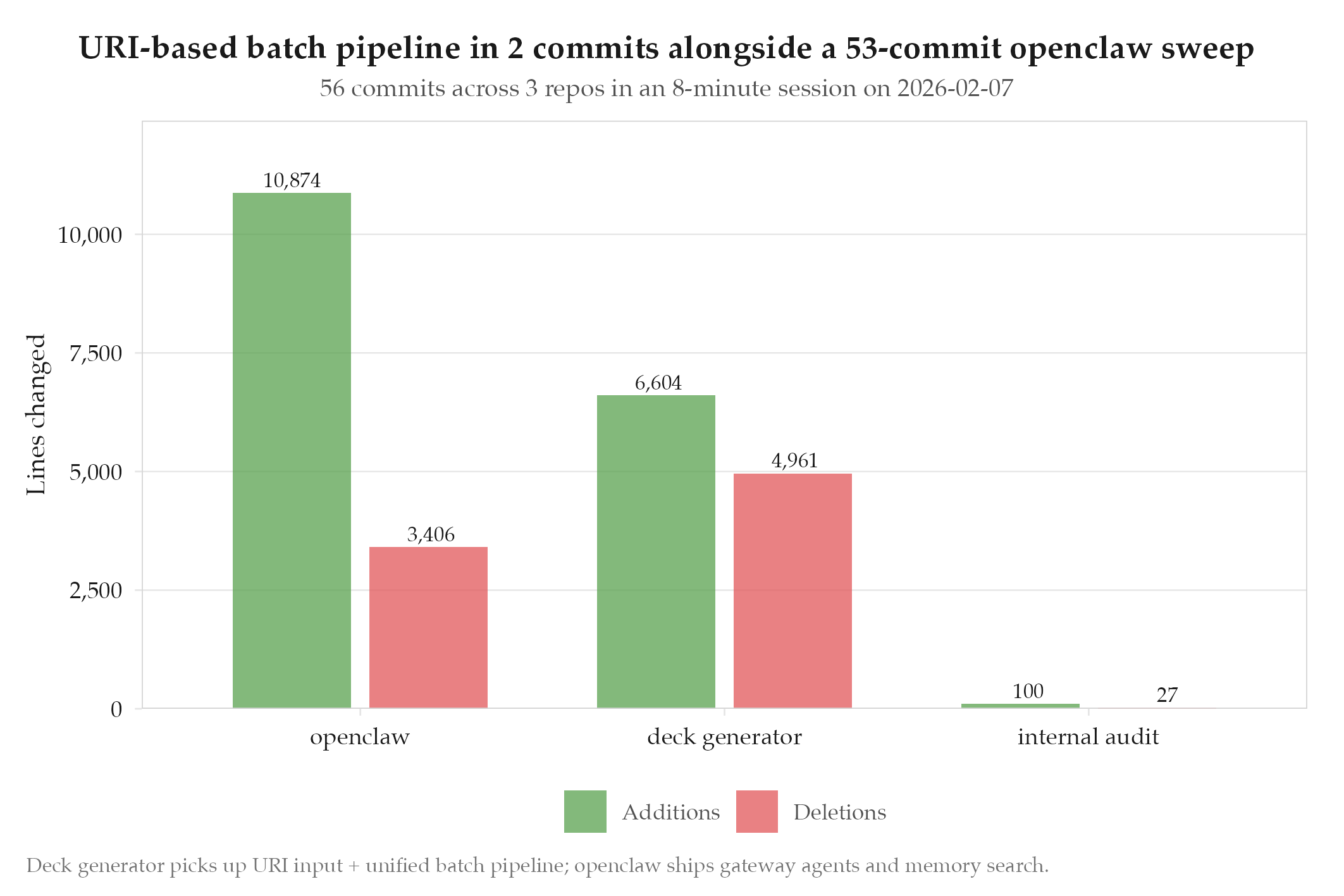
1 session, 8 minutes, 56 commits across 3 repos. 25,293 lines added, most of it openclaw. The session length is the tell: 56 commits in 8 minutes is batched automation flushing its queue, not a human deciding 56 things.
Evidence
brandhouse_ppt picked up URI-based input and a unified batch pipeline in 2 commits: 6,604 additions, 4,961 deletions. The URI input change lets the deck generator take a pointer rather than raw content, which is what unlocks programmatic invocation from upstream pipelines. The unified batch pipeline replaces what had been ad-hoc single-item invocation with a shape that handles many decks in one run and shares setup cost across them.
openclaw ran 53 commits in parallel with the brandhouse_ppt work: 10,874 additions, 3,406 deletions, touching docs, gateway agents, memory search, and test suites. The gateway commit added agents.create, agents.update, and agents.delete methods, which is the CRUD surface that external systems need to manage agent state programmatically. Native Voyage AI memory support shipped the same day, which plugs Voyage’s embeddings directly into the memory search path rather than going through an adapter.
The session totals: 1 session, 8 minutes, $0.70 compute. Three repos touched across the window: brandhouse_ppt, openclaw, and an internal audit pipeline that took a small contribution. The split across repos in a single 8-minute session is another signal that most of the commits came from batched automation rather than interactive work.
So What
URI-based input in brandhouse_ppt means the deck generator can now be driven programmatically from any upstream pipeline. The batch abstraction unlocks that; without a batch pipeline, every programmatic invocation pays full setup cost, which makes the feature usable only for one-off runs. With the batch shape in place, the generator can sit behind an automated workflow that produces dozens of decks per invocation.
openclaw’s 53-commit day reflects a dependency cascade, not 53 independent decisions. The gateway agent methods and memory search mode likely share a common interface layer, and a change to that layer propagates through every consumer. When I see 53 commits touching docs, gateway, memory search, and tests all at once, the default interpretation is that one architectural change at the center rippled outward. That is a different kind of day than 53 separate improvements, and it carries different risks; a cascade that misses one consumer leaves a broken edge that will surface later.
Native Voyage AI memory support is the piece I expect to matter most over time. Memory search is a foundational capability for the kind of agent workflows openclaw is built to run, and having native Voyage support rather than an adapter means the embedding quality and latency are under direct control instead of filtered through a translation layer.
What’s Next
The unified batch pipeline in brandhouse_ppt needs an end-to-end test from a URI input to a rendered slide. The failure mode I need to probe is malformed input: what breaks when the source document at the URI is missing required sections, has malformed structure, or is simply empty? A batch pipeline that silently skips bad inputs is worse than one that fails loudly; silent skips produce partial outputs that look complete.
On openclaw, the agents.create / update / delete surface needs an idempotency story. External systems that call these methods from automation are going to retry, and retries without idempotency produce duplicate state. I want to confirm that retry behavior is safe before anyone outside builds on the new methods.
Log
- Sessions: 1 across 1 projects, 8m total
- Top projects: brandhouse_ppt (8m)
- Commits: 56 across 3 repos (+25293, -8394)
- Top repo: openclaw (53 commits)
- Cost: $0.70