Brand House deck generator ships: 20 slides from a single init commit
Signal
Two repos moved hard today. brandhouse_ppt landed a 20-slide brand deck generator in a single initial commit. openclaw absorbed 80 commits in the same session window. Total of 16,275 lines added across the day.
Evidence
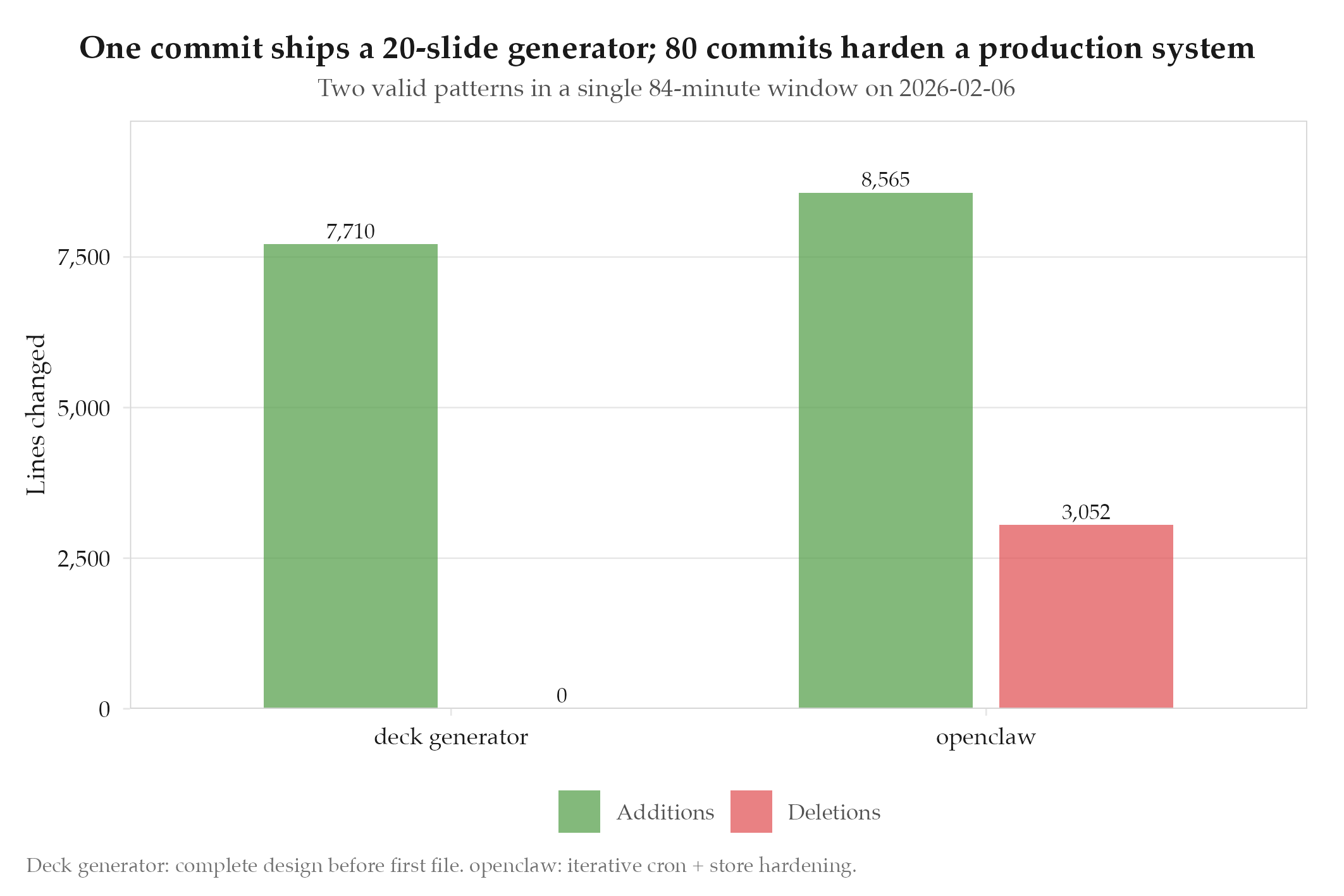
brandhouse_ppt opened with its initial commit dropping 7,710 lines, a complete 20-slide deck generator from scratch. A first commit at that size is unusual and tells me something specific about the shape of the work: the design was fully scoped before code got written. The slides, the layout logic, the content hooks, and the generator itself all arrived together because they had to arrive together. A half-built deck generator is not a testable artifact; a 20-slide generator either renders all 20 or reveals its gaps immediately.
openclaw absorbed 80 commits in the same session window: 8,565 additions, 3,052 deletions. The work targeted three areas that often travel together on a reliability day: cron scheduler reliability, store hardening, and control UI asset handling. Cron reliability is the part I treat as load-bearing; a scheduler that sometimes loses jobs is worse than no scheduler at all because users lose trust in the feature rather than in their usage of it. Store hardening means tightening the state layer so that concurrent writes and partial failures do not corrupt persisted data. Control UI asset handling is the less glamorous piece: making sure static assets resolve correctly across package boundaries so the UI does not ship with broken icons or missing stylesheets in some install paths.
4 sessions, 84 minutes, $1.31 in compute across 2 repos. The compute number is small for the amount of work shipped, which tells me most of the 80 openclaw commits were small targeted changes rather than large AI-assisted rewrites. Total diff for the day came to +16,275 / -3,052, with brandhouse_ppt contributing roughly half the additions and openclaw contributing the rest.
So What
Shipping a 20-slide generator as a single initial commit means the design was complete before the first file was created. That is the opposite of how most projects start, where a scaffolding commit lands first and features accrete on top. The single-commit pattern works when the scope is tightly bounded and the contracts between modules are already figured out. It fails when the scope shifts after the first commit, because the clean initial structure resists change.
openclaw’s 80-commit day tells a different story: iterative hardening across a system already in production. When a mature system moves 80 commits in a window, most of those commits are small because the architecture is already chosen; the work is fit-and-finish. That is a different discipline than greenfield design and it requires a different kind of attention. Both patterns are valid; neither is the one people talk about when they talk about how software gets made.
What I want to name is the combination of the two on the same day. A greenfield commit landing on brandhouse_ppt while openclaw takes 80 iterative commits means I was context-switching between two very different modes of engineering attention. I can feel the fatigue cost of that switch, and it is the kind of cost that shows up in the quality of the smaller decisions rather than the big ones.
What’s Next
openclaw’s cron scheduler fix needs validation under real load. Does the store hardening hold when the scheduler runs overnight? The failure mode I am worried about is long-tail: a scheduler that works fine for the first 6 hours and drifts in ways that only show up after hour 12 when state accumulates. I want a 24-hour soak before I call the hardening done.
For brandhouse_ppt, the question is whether the 20-slide structure survives contact with the first real brief. A generator that works for the first use case and bends awkwardly for the second is a brittle generator. I want to push two unrelated briefs through it this week to see where the joints creak.
Log
- Sessions: 4 across 2 projects, 84m total
- Top projects: brandhouse_ppt (75m), misc/Documents (9m)
- Commits: 81 across 2 repos (+16275, -3052)
- Top repo: openclaw (80 commits)
- Cost: $1.31