159 openclaw commits: Mintlify MDX fix, auto-scroll on user send
Signal
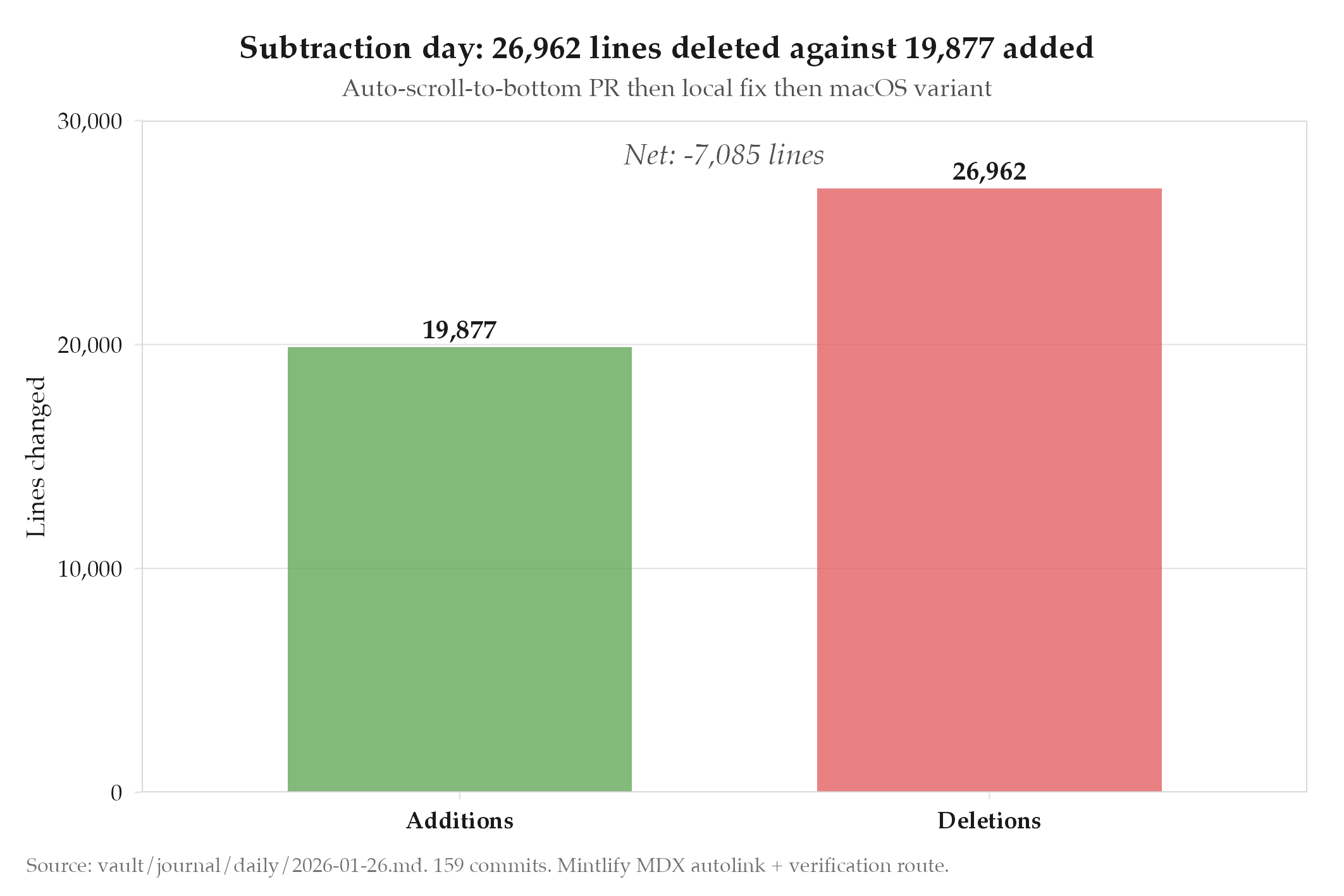
159 commits into openclaw, +19,877 / -26,962: a rare net-negative diff day Mintlify MDX autolink fix (#2584) and formal-verification route repair (#2583) landed in the docs pipeline Auto-scroll-to-bottom fix on user send (#2471) was applied, then re-patched locally, then hardened for macOS
Evidence
openclaw: 159 commits, +19,877 additions, -26,962 deletions (net -7,085)
docs: fix Mintlify MDX autolink (#2584) and docs: fix formal verification route (#2583): two docs-infra fixes same day
fix: auto-scroll to bottom on user send (#2471) (thanks @kennyklee): contributor fix, accepted
fix: local updates for PR #2471: the contributor fix needed follow-up touches
fix(macos): auto-scroll to bottom when sending message while scrolled up: platform-specific variant same day
Net-negative day: 7K more lines deleted than added, which is the signature of a cleanup sweep
The three-commit chain on #2471 is the story of the day. An outside contributor spotted the bug, wrote a fix, and submitted it. I took the fix, merged it, then found it did not cover my own local setup. Patched that. Then macOS users reported that the fix still did not work when the message was sent while the scroll was already off the bottom. Patched that too.
So What
This is subtraction day. The diff profile (26K out, 19K in) means I was deleting more than writing: old docs routes, dead scroll logic, stale MDX. The auto-scroll PR-then-local-fix-then-macOS-variant chain is the shape of a bug that hides under three different rocks. Each layer caught a different platform edge case. Kennyklee saw it on his setup, I saw it on mine, and macOS users saw a third variant. Bug reports from three different environments usually mean the fix is not surgical enough; you are patching the symptom at each call site instead of the underlying cause.
The Mintlify fixes are separate; they share only the day. The MDX autolink was a docs rendering issue where links were not getting the right href. The formal-verification route repair was a 404 on a docs page that had been moved. Both are docs-infrastructure bugs, not product bugs, but they matter because the docs site is the first thing a new user sees.
Net-negative days are interesting because they are easy to undercount. A 7K line net deletion means I shipped less new code than the commit count suggests; most of the 159 commits were pruning or rewriting existing surface. The relief of a net-negative day is usually temporary: the backlog of “should delete” work fills up again within two weeks.
What’s Next
Net-negative days pay interest. Do the deletions reduce surface for #2471-style multi-layer bugs, or just clean up elsewhere? If the deletions touched the scroll code path, the fix is more likely to hold. If they were docs-only, the auto-scroll bug may surface again on the next rerender refactor.
The three-commit auto-scroll chain suggests there is a fourth variant waiting somewhere: Windows users or mobile web. Worth searching the issue tracker for anything scroll-related in the next week. If a fourth variant surfaces, that is a strong signal the fix needs to move further up the call stack; right now each commit patches a different consumer of the scroll logic instead of the shared helper underneath them. The Mintlify docs work is a reminder that docs infrastructure has its own failure modes independent of product code. A broken docs route can block a user as hard as a broken feature, and the signal latency is often worse because docs errors do not alert.
Log
- Sessions: 0 across 0 projects, 0m total
- Top projects: none (no session telemetry)
- Commits: 159 across 1 repos (19877 +, 26962 -)
- Top repo: openclaw
- Cost: not tracked