OpenClaw velocity: 209 commits, 93K lines touched in one session
Signal
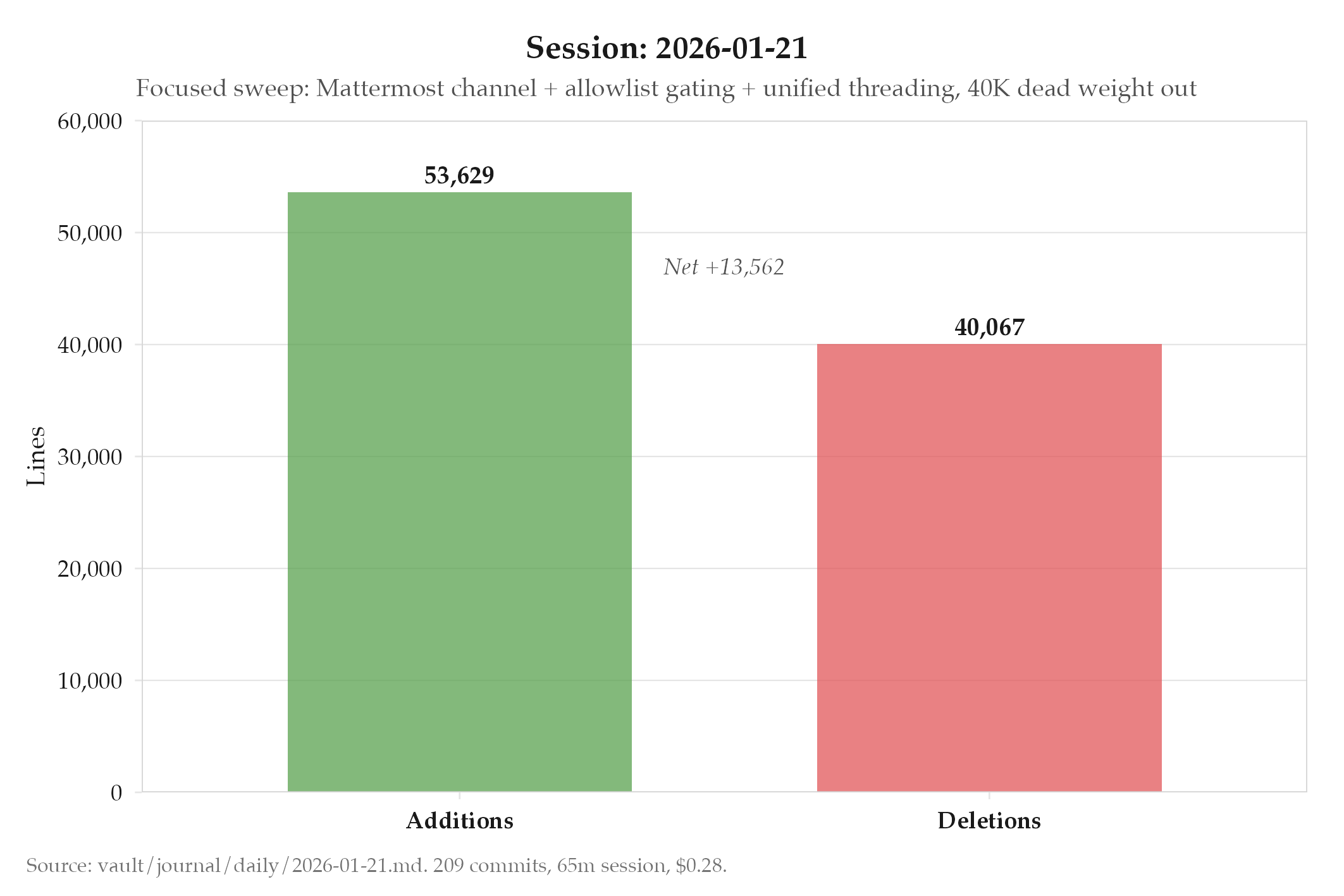
209 commits landed in openclaw across 65 minutes of session time. That’s a net +13,562 lines after 40K deletions, meaning a major sweep happened alongside the additions. Mattermost support, allowlist gating, and threading unification all shipped in the same window.
Context
The last ten days have been the whole shape of a protocol runtime growing up. Plugin architecture on January 11, memory and sandbox on January 12, 2026.1.14 release prep on January 13, module split on January 14, first external-contributor PR on January 15, first internal audit pipeline commits on January 16, subagent visibility on January 17, Twilio fix cluster on January 18, stabilization on January 19, theming on January 20. Today is the first day where a brand-new channel (Mattermost) gets added through the plugin path, and the allowlist gating ships at the same time because both new channels and new commands need a shared gate before any of them can be trusted at once. Tomorrow (January 22) pushes agent avatars and extracts Mattermost into its own plugin extension, so today is the “add it, then we’ll extract it” side of that pair.
Evidence
2 sessions, 65 minutes, $0.28 total cost
openclaw: 209 commits, 53,629 additions, 40,067 deletions
feat: add Mattermost channel support and refactor: unify threading contexts in the same batch
feat: tighten exec allowlist gating alongside feat: add /allowlist command
feat: implement short ID mapping for BlueBubbles messages and enhance reply context caching
fix: emit diagnostics across channels closed out the run
So What
This is what a focused protocol sweep looks like: channel surface expanded, auth normalized, exec gating hardened. The 40K deletion number is the signal, not the additions. Dead weight came out. What remained is leaner and more defensible. A protocol layer that grew across ten days of pushes had accumulated a lot of copy-paste between adapter implementations, and pulling shared pieces into unified threading contexts is how that debt gets retired. Allowlist gating landing at the exact moment a new channel ships is the right coupling. Any time you add a protocol surface, you also add a trust surface, and the gate has to move forward in lockstep with the surface. An allowlist command that lets users manage the gate without editing config files is the user-facing half of that; the exec-gating tightening is the backend half. Both in one commit run. 65 minutes of session time for 209 commits at $0.28 is a near-zero cost per commit. This is the profile of an author who knew exactly what they wanted and was running mostly in a local test-commit-test loop rather than querying the model for design help. That kind of session is cheap but also carries the risk of not catching the thing you didn’t know to ask about; the next few days of bug commits are the place to spot any of that.
What’s Next
Threading context is unified now across channels. Does the allowlist gate hold under multi-channel concurrency, or does state bleed between contexts? The right test is a user active on two channels at once with different permissions on each; if the gate is scoped correctly the channel boundary holds, if it isn’t, the failure shows up as “allowed action on wrong channel” rather than “denied action on right channel,” which is the more dangerous of the two directions. Tomorrow’s Mattermost extraction is probably where that shakes out.
Log
- Sessions: 2 across 1 projects, 65m total
- Top projects: misc (Documents) 65m
- Commits: 209 across 1 repos (53629 +, 40067 -)
- Top repo: openclaw
- Cost: $0.28