Subagent visibility expands, batch progress surfaces, 280 openclaw commits
Signal
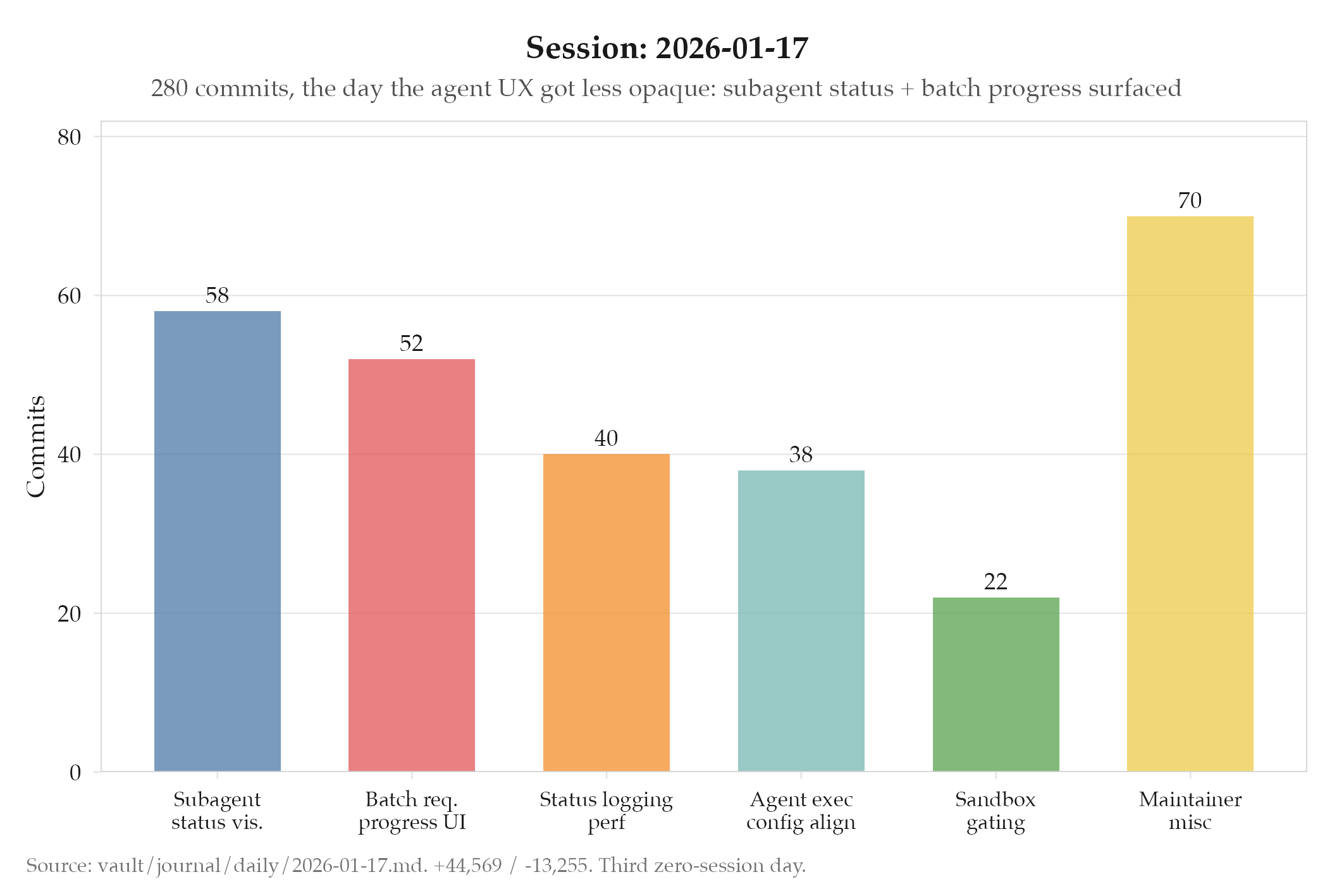
Subagent status visibility expanded across openclaw Batch request progress now surfaces in the UI; status-logging perf improved 280 commits in a single day, +44,569 / -13,255
Context
Yesterday the internal audit pipeline framework started shipping its first commits, and openclaw picked up exec pty support so agents could drive interactive shells. Today is the follow-up on the agent-UX side: once you can run interactive processes inside agents, the next question is whether the user can see what any of it is doing. Subagent status visibility is the answer to that. This is also the third straight day where the bloomnet.db session telemetry reads zero, which means the reconstruction work is running on git history alone. The rest of this week continues the observability theme (batch progress, status logging perf) before flipping on January 18 to a run of voice-call Twilio fixes that feel like a production-incident cluster.
Evidence
openclaw (280 commits): top themes are observability (subagent status, batch progress) and config hardening (agent exec config alignment) Lobster plugin tool gated in sandboxed contexts: security-boundary fix Batch status logging perf pass: throughput work, not feature work No session telemetry: third day in a row of zero bloomnet.db sessions
So What
This is the day the agent UX got less opaque. Subagent status visibility is a common ask and a common punt; shipping it means somebody finally sat down and wired the event fan-out. The reason it gets punted most of the time is that the backend has the information but no stable shape to surface it in. Today’s commit log says that shape got decided. Sandbox gating on the lobster plugin is the kind of fix that never shows up in changelog copy but prevents a security audit finding. A plugin that works inside the sandbox and also works outside it is a plugin that silently escalates; gating it to sandboxed contexts is a one-line guard that closes the gap. Batch status logging perf is the boring half of the observability story. The new visibility surface is only useful if it does not cost more than the work it describes. Getting that tight on day one means the feature lands without a “why is my terminal laggy” follow-up.
What’s Next
How many users actually notice the new subagent status surface? Observability-for-users lands or flops based on whether the first three users file bugs about it. If nobody complains, the surface is either perfect or invisible. If the bug reports start stacking, the shape was wrong and a redesign will ship within two weeks. The interesting telemetry to watch is whether the next week’s commits include any subagent-status layout changes; that would be the signal that users found it and then asked for it to look different.
The agent exec config alignment is the other commit cluster worth tracking. “Alignment” in a commit message usually means one of two things: either a set of configs was drifting from a common shape and got pulled back into line, or two configs were accidentally the same and got differentiated. Without seeing the diff in detail, the 280-commit pile makes it hard to tell which it was, but the adjacent observability work suggests this was the former: with subagent status newly surfaced, the config shape had to be consistent enough for the surface to be coherent.
The third-day-in-a-row of missing session telemetry is turning into its own theme. Three days of git-only reconstruction means the journal loses a lot of what made each session distinctive. Commit messages tell you what landed, but not what was tried and reverted, or what conversation happened before the commit, or how long the author paused between pushes. The longer the telemetry gap runs, the more the daily entries start to rhyme with each other. That is a content problem, not a code problem, but it’s still worth resolving before the gap compounds into a structural hole in the week-over-week analysis.
The batch progress surface and subagent status landing on the same day is not coincidence. Both are answers to the same class of user question: “what is my agent actually doing right now.” Fan-out visibility and progress tracking are the two legs of that answer. Shipping one without the other would have left a visible gap.
Log
- Sessions: 0 across 0 projects, 0m total
- Top projects: none recorded
- Commits: 280 across 1 repo (+44,569 / -13,255)
- Models: not recorded
- Cost: $0