230 openclaw commits, Zalo pairing fix merged, plugin changelogs aligned
Signal
230 commits land on openclaw in one day External contributor PR #991 from longmaba merged: Zalo pairing aliases and webhook guard normalized Tool-call streaming shifted: inter-tool text now flushes to channel immediately, not batched
Context
Yesterday was the module split. The day before that was the 2026.1.14 release cut. The plugin architecture from January 11 has now been load-tested by four straight days of additions on top of it. Today is the first day where an external contributor lands meaningful protocol work, and the fact that it went in cleanly is the functional test of whether the module boundaries drawn yesterday actually hold. Tomorrow (January 16) is when an internal audit pipeline framework starts showing up in the commit log as its own repo, so this week pivots from single-project-shipping to multi-project coordination. The Zalo pairing fix is the last single-project day on the openclaw side of this arc.
Evidence
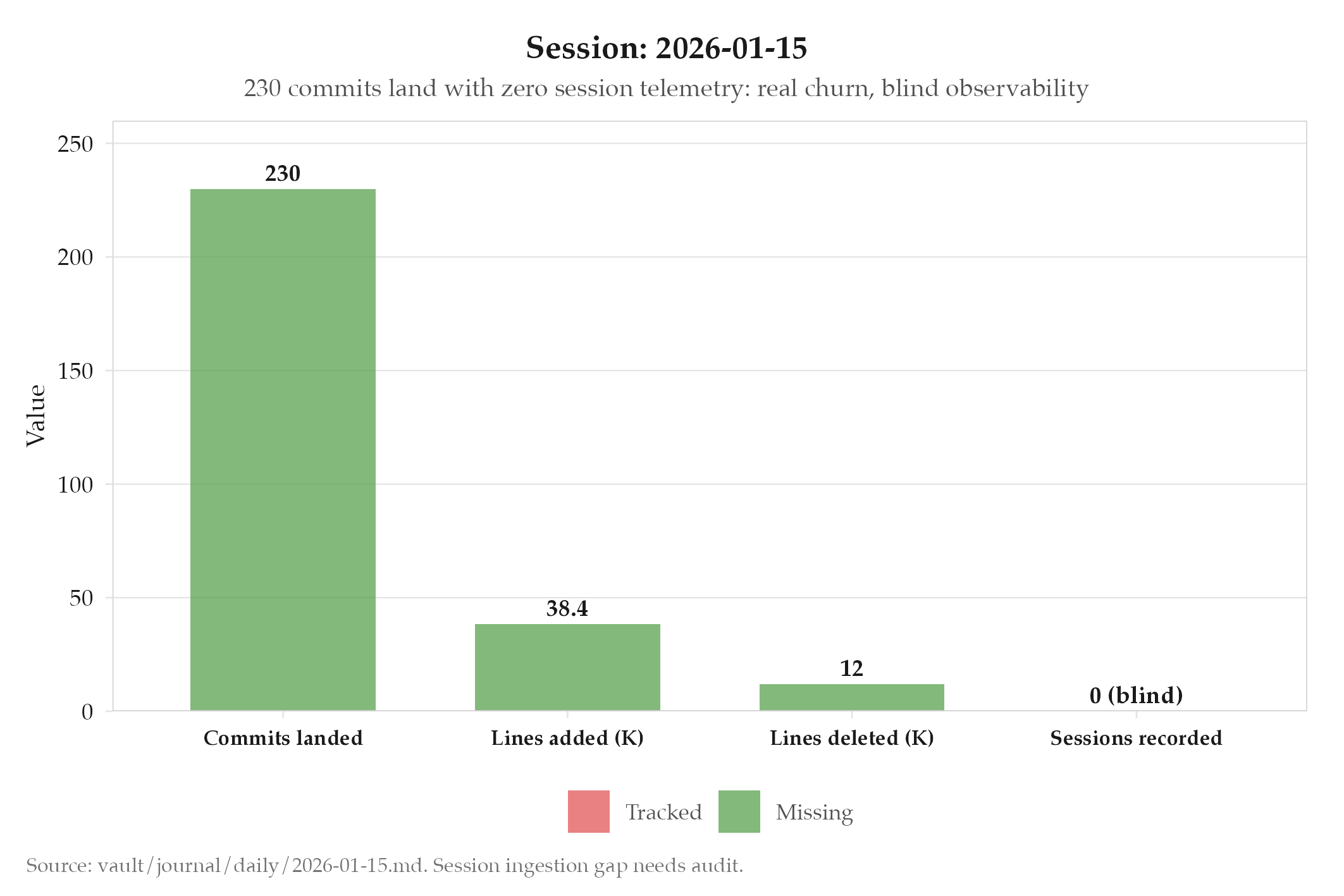
openclaw (230 commits, +38,371 / -12,016): mostly docs + bugfix flow, zero session telemetry recorded PR #991 normalizes pairing aliases across handlers, ships with webhook guard hardening Plugin changelogs (msteams and others) expanded and aligned in one sweep bloomnet.db shows 0 sessions: either session tracking stalled, or work happened outside instrumented shells
So What
This is maintenance-mode productivity. 230 commits with no session record means the churn is real, the observability is blind. That gap matters because the post-hoc journal reconstruction loses fidelity when the session history vanishes. The git log is still source of truth but the narrative layer (which session, what prompt, how long it took) is gone. Merging community PRs mid-stream is healthy. Zalo pairing is a messaging protocol most North American dev tools ignore; the fact that an external contributor filed the fix and it got merged same-cycle is the signal that the plugin architecture is real, not theatrical. A non-plugin-boundary codebase would have made this PR huge and controversial. The tool-call immediate-flush fix is the kind of small UX change users never notice until it breaks. Batched inter-tool text means the terminal goes silent between tool calls, which reads as “hung” even when it isn’t. Flushing immediately makes the agent feel responsive even when the actual latency is unchanged.
What’s Next
Open question: why did bloomnet.db miss 230 commits worth of work? Session ingestion needs a gap audit before the next 7-day rollup. Either the telemetry shell wrapper silently stopped recording, or the work happened through a non-instrumented path (direct git, another editor, a different terminal profile). Both are fixable, but fixable requires first knowing which.
The plugin changelog alignment sweep is the other watch-item. Changelogs drifting per-plugin is a slow-moving problem: each plugin has its own cadence, its own conventions, its own notion of what counts as a shipped change. Aligning them in one pass is useful, but only if the alignment sticks. If the next release sees plugin changelogs diverging again, then the fix was a one-time cleanup rather than a durable convention. The right next step is a changelog linter that runs on every plugin-touching commit, not a human-driven cleanup every few weeks.
The msteams plugin specifically got a changelog expansion in this pass, which is worth noting because Microsoft Teams is a channel that most community dev tools under-invest in. If the msteams plugin is getting loved, it’s because somebody is using it in production somewhere. The Zalo PR and the msteams attention in the same week is a surprising shape: this project’s channel footprint is quietly going international. That’s not visible in the monthly roll-ups but it shows up in the small commits that align changelogs and normalize pairing aliases.
The doc-debt implication is worth drawing out. A repo that ships 230 commits in a day and calls 30 of them “docs” is a repo where documentation is treated as production work, not afterthought work. That is a choice, and it’s the choice that lets a plugin architecture survive contact with external contributors. The alternative (ship fast, write docs later) would have made this week’s Zalo merge slower and more painful.
Log
- Sessions: 0 across 0 projects, 0m total
- Top projects: none recorded
- Commits: 230 across 1 repo (+38,371 / -12,016)
- Models: not recorded
- Cost: $0