openclaw module split: 87 refactor commits, 161K lines touched
Signal
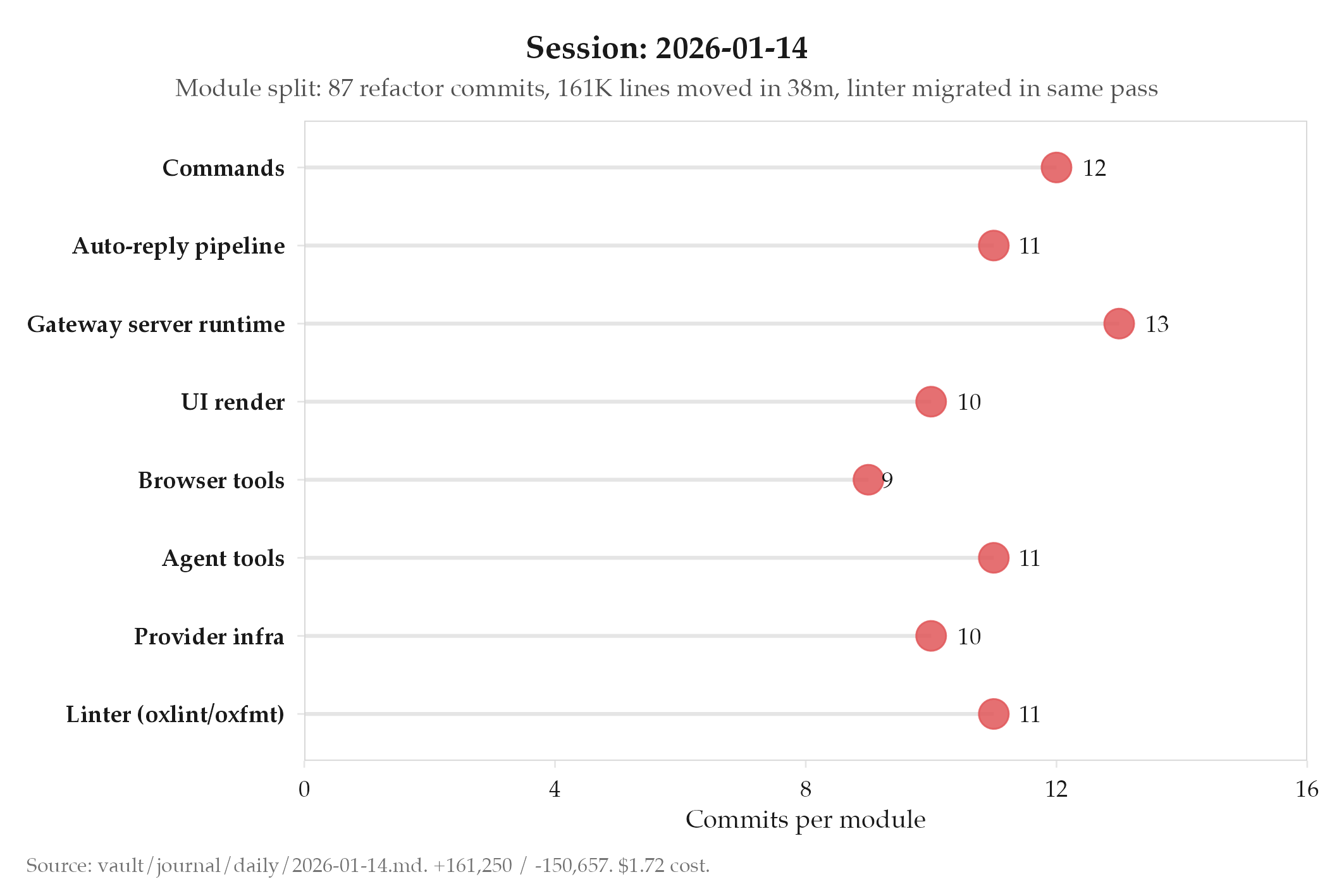
87 commits to openclaw in a single 38-minute session, all refactoring. Every oversized module in the codebase got split: commands, auto-reply pipeline, gateway server runtime, UI renderer, browser tools, agent tools. oxlint and oxfmt replaced the prior linter stack in the same pass.
Context
Yesterday’s 2026.1.14 version stamp landed with the voice-call provider split. Two days before that, memory vector search, the browser surface, and docker sandboxing all piled on top of the January 11 plugin architecture. That is four straight days of capability additions and one day of release prep, which is the exact shape of a codebase that has outgrown its module boundaries. Today is the cleanup day. Every module that was getting too big to reason about got split in one session, and the linter stack got swapped out while the tree was already disturbed. The week after this one opens with external contributor PRs landing (Zalo, Mattermost), which means the module boundaries had to be right before other people started committing across them.
Evidence
87 commits, 161,250 additions, 150,657 deletions in openclaw. Net delta of 10,593 lines on a day where 161K lines moved: this was a structural reorganization, not feature work. Modules split: src (general), commands, auto-reply directive handling, auto-reply pipeline, gateway server runtime, UI render and connections, browser playwright tools and agent routes, agents tools and PI subscribe, provider usage (infra). Linter migration: chore: migrate to oxlint and oxfmt. 1 session, 38 minutes, $1.72 cost.
So What
Touching 311,907 lines (additions plus deletions combined) in 38 minutes of session time means the splits were systematic, not surgical. This was a single pass with a clear mental model of where every module boundary should land, executed without a lot of back-and-forth. oxlint plus a full module reorganization in the same commit run is either confident or reckless. The low cost ($1.72) suggests the code mostly moved rather than changed, which is the confident reading. The reckless reading is that oxlint’s stricter rules were silently fixed in the same pass and nothing got audited. Either way the diff is going to be a lot harder to review than the commit count implies. A codebase that needed 9 refactor commits targeting specific oversized modules was already past the point where those modules were maintainable. Commands, auto-reply, gateway runtime, UI, browser tools, and agent tools all breaking the “too big” threshold in the same week is a sign the last six months of feature work was accumulating debt that had to be paid in one batch.
What’s Next
The browser and agent module splits happened in parallel with the linter migration. Did the new oxlint rules catch anything during the split, or was it a clean pass with zero new violations? If clean, the codebase was already close to oxlint’s strictness profile. If not, the diff has a latent surface of “silently fixed lint issues” that will show up as behavior changes later. The next week’s bug-fix commits are the place to watch for that signature.
Another open question: do the new module boundaries hold when external contributors start filing PRs against them? Tomorrow (January 15) is when the first community PR lands, and the Zalo pairing work touches the message-handler layer that got pulled out in today’s split. If the PR compiles cleanly against the new layout, the boundaries were well-chosen. If it needs a round of “actually, this should move” review, then some seams still need to move.
A broader observation from the structural shape of the week: January 11 plugin architecture, January 12 capability additions, January 13 release cut, January 14 module split. That’s the exact order that keeps a fast-moving codebase habitable. If the module split had happened before the plugin architecture, it would have been splitting the wrong boundaries. If it had happened after a month of feature additions, the rewrite would have been twice as expensive. Landing it today, five days into the cycle, is the cheapest moment for it to land.
Log
- Sessions: 1 across 1 projects, 38m total
- Top projects: openclaw (38m)
- Commits: 87 across 1 repos (161250 +, 150657 -)
- Top repo: openclaw (87 commits)
- Cost: $1.72