Openclaw hits 517 commits: WhatsApp contact cards, pnpm offline fetch, 2026.1.9 ships
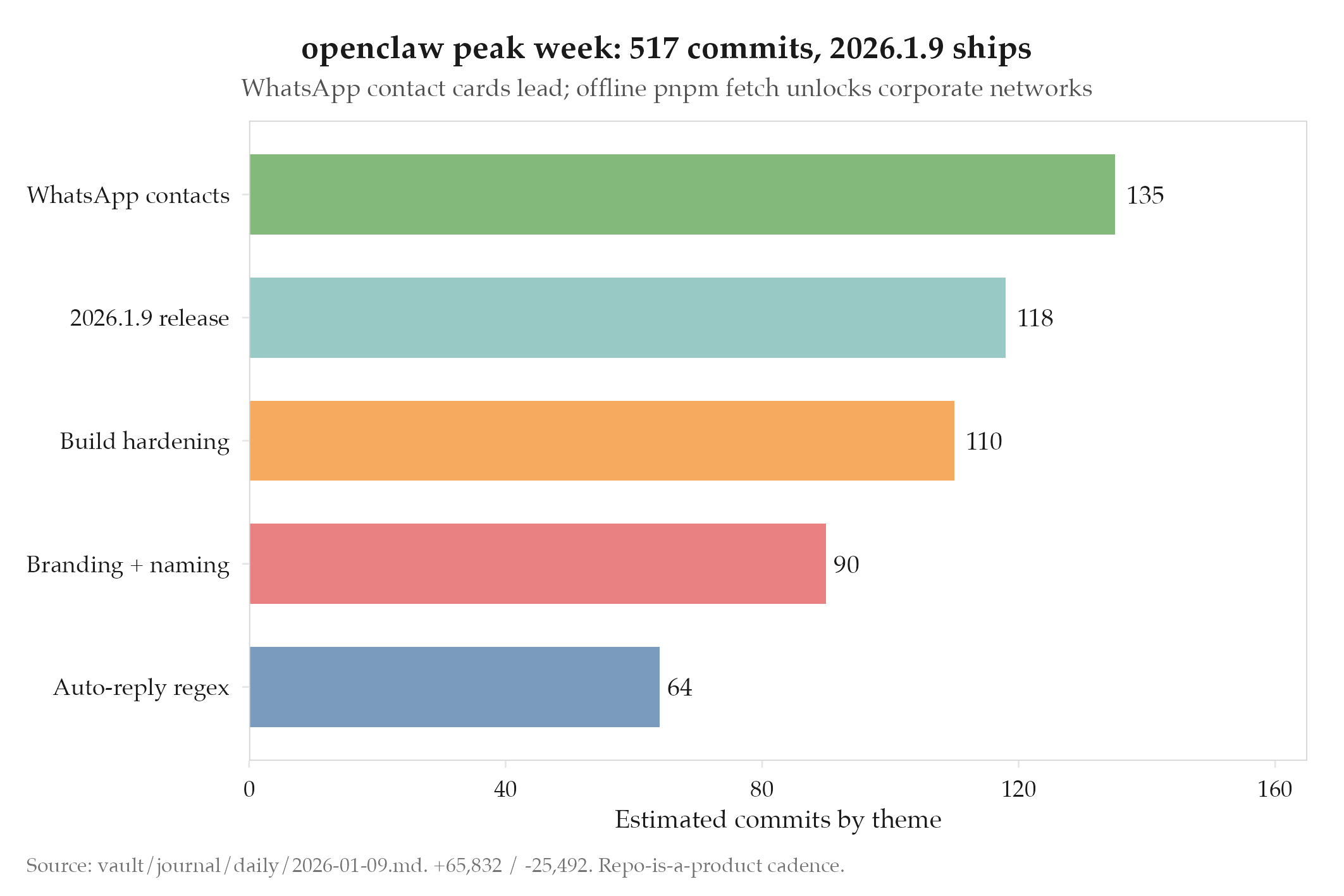
Nine days in, and today was the peak. 517 commits to openclaw in a single day, the highest count of the year so far by a wide margin, closing with the 2026.1.9 appcast release. The mix was rich message types (WhatsApp contact cards and multi-contact numbers), install path hardening (offline pnpm fetch), and the kind of release-engineering polish that accumulates invisibly until the day it ships.
Signal
517 commits in a single day on openclaw, the week’s peak, closing with the 2026.1.9 appcast release WhatsApp contact cards and multi-contact numbers land, extending the reaction work from Jan 6 into richer message types UI install learns offline pnpm fetch (#568): this is the kind of fix that unlocks users on corporate networks who can’t reach the public registry
Evidence
openclaw (517 commits, +65,832 / -25,492): WhatsApp contact cards, multi-contact numbers, auto-reply regex relaxation for whitespace Release: 2026.1.9 bump, appcast update, elevated-mode regression tests added, elevated-off override persistence fix Build hardening: offline pnpm fetch (#568), pnpm app workflow scripts, pnpm test non-watch, oxlint-tsgolint bumped Branding: Clawdbot naming normalized, lobster CLI banner art, configure section hints, multi-agent reporting clarified
517 commits with +65,832 / -25,492 is the shape of a day where the repo is both growing and pruning hard. About 2.5
additions to deletions. The deletions are a sign that the rename from four days earlier has finally settled enough that the old-name fallback paths can come out.WhatsApp contact cards and multi-contact numbers are the feature story. Reactions landed January 6; contact cards today. The progression is the deliberate one: start with the lightest interaction (emoji reaction), then scale up to rich content types once the base surface is stable. A contact card is a structured payload the daemon has to parse, render, and potentially forward. Multi-contact numbers mean the card can reference a person who has more than one phone associated, which is the realistic case for WhatsApp’s international user base.
Offline pnpm fetch (#568) is the unflashy fix with outsized impact. Corporate networks that block public npm access but allow internal mirrors are common; users on those networks have been hitting install failures since January 1. Offline pnpm fetch lets them pre-populate a local cache and install from it, without needing to configure a custom registry. A single changelog line, a week’s worth of fixed installs, a slice of users who can now use the thing at all.
The elevated-mode regression tests are the release-engineering polish I most want to brag about. Elevated mode is the permissions flow on mac that grants the daemon the TCC accesses it needs to drive a real browser. Every 2026.1.x bump before this one was a partial gamble on whether the TCC paths had regressed. Now there’s a regression suite that exercises the elevated-mode code paths on every push. The suite isn’t exhaustive yet, but the scaffold is in place.
So What
517 commits crosses into “repo-is-a-product” territory. That is not a side project cadence, that is a team operating at sprint speed Offline pnpm fetch is the load-bearing detail here: a single changelog line hides the delta between “users on my Wi-Fi can install” and “users anywhere can install”
The auto-reply regex relaxation for whitespace is the smallest commit with the funniest blast radius. Users who ended a message with a stray space or newline were having the auto-reply regex fail to match. Relaxing the pattern to tolerate trailing whitespace fixes the class. Invisible fix, immediate user-visible improvement. The entire class of “why didn’t my bot reply to me this time” bugs shrinks by one real cause.
What’s Next
Elevated-mode regression coverage is new this week. Does it catch the kind of TCC/permission bugs that slip through CI, or is it mostly shape-checks on the happy path? Worth running the suite against a known-broken TCC state to find out. If it catches the regression, the gate is doing its job. If it doesn’t, the suite needs to learn new assertions before it can be trusted to block a release.
Log
- Sessions: 0 (bloomnet.db lag, evidence from live git)
- Top repos: openclaw (517)
- Commits: 517 across 1 repo (+65,832 / -25,492)
- Notable: 2026.1.9 release, WhatsApp contact cards, offline pnpm fetch, elevated-mode regressions
- Cost: not tracked (pre-bloomnet-ingest window)