Vault Knowledge Engine v1: 12,600 lines, 5 crates, 20 MCP tools, live in production
Manual vault: grep-based search, LLM audit skills (30-60s each), no agent access, no quality metrics -> 5 Rust crates, 12,600 LOC, 137+ tests, 72 scanners (<2s for 19K checks), 20 MCP tools, hybrid search (BM25+HNSW), KQI 7-component quality index, rv CLI with 14 commands
What Changed
The vault went from a manually maintained Obsidian wiki (grep-based search, LLM audit skills running 30-60s each, no programmatic access) to a real knowledge engine backed by 5 Rust crates and 12,600 lines of code. Every dimension, lifecycle chain, and quality metric is now computable in under 2 seconds. Agents can query the vault through 20 MCP tools over stdio JSON-RPC without ever touching the filesystem directly.
Key Metrics
| Metric | Before | After |
|---|---|---|
| Search | grep / manual | BM25 + HNSW hybrid (RRF fusion) |
| Audit speed | 30-60s per skill (LLM) | <2s for 19,475 scanner checks |
| Scanners | 0 (LLM-based) | 72 deterministic scanners, 7 categories |
| Agent access | None | 20 MCP tools + 5 resources |
| Quality metric | None | KQI (7 weighted components) + Karpathy ratchet |
| Tests | N/A | 137+ passing |
| CLI commands | None | 14 subcommands (rv binary) |
Architecture
The engine uses a frame-graph model inspired by Memvid’s smart frames, but built natively in SQLite rather than depending on Memvid’s single-writer lock and flat SPO triplet structure. This is Approach C from the three-way architecture evaluation documented in experiments/bloomnet/2026-04-08-vault-engine-approach-c.
The five crates:
- vault-core: SQLite (12 tables), tantivy BM25 full-text, HNSW vector index, ONNX Runtime embeddings (bge-small-en-v1.5, 384d), RRF fusion scoring, visibility gates, temporal queries, graph traversal, inotify file watcher
- vault-scanners: 72 scanners across frontmatter validation, link integrity, lifecycle chain checks, content quality, schema compliance, temporal consistency, and cross-reference density
- vault-eval: KQI (Knowledge Quality Index) with 7 weighted components, Karpathy-style ratchet that only accepts improvements
- vault-mcp: 20 tools + 5 resources exposed over stdio JSON-RPC 2.0, compatible with Claude Code MCP registration
- vault-cli: the
rvbinary with init, index, search, audit, eval, watch, serve, and 7 more subcommands
Competitive Context
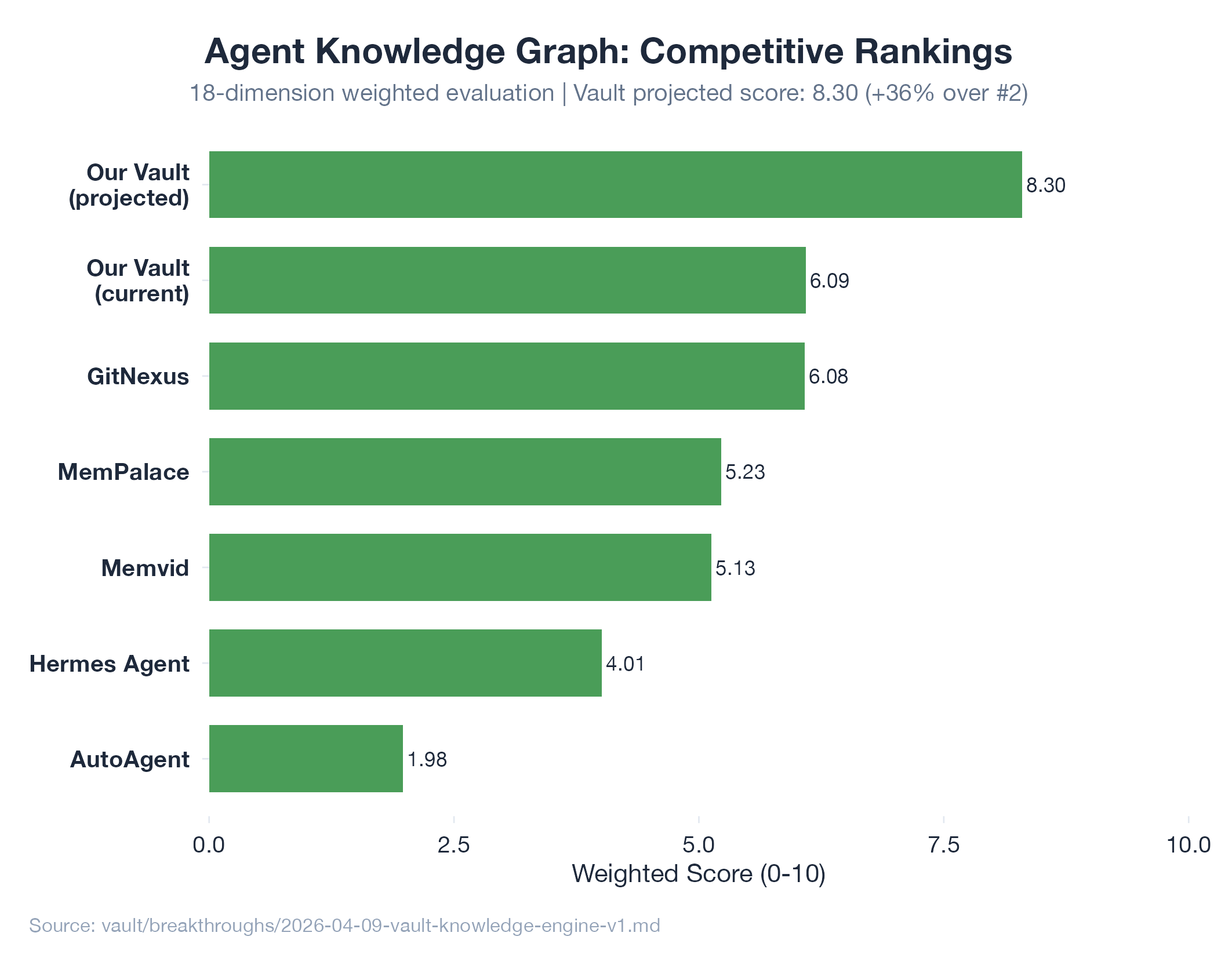
A parallel Opus sub-agent competitive analysis crawled 6 knowledge management systems (MemPalace, GitNexus, AutoAgent, Hermes Agent, Memvid, and our vault) across 18 weighted dimensions. Before the engine, the vault scored 6.09 (GitNexus: 6.08). With the engine additions, the projected score jumps to 8.30, representing a 36% lead over the next system. The differentiator: no other system combines a deep typed knowledge graph + lifecycle chains + audit ratchet + hybrid retrieval + temporal frames + MCP agent access in a single architecture.
What It Enables
- Agent-queryable vault: any Claude Code session with the MCP server registered can search, traverse, and audit the vault without filesystem access
- Deterministic quality gates: 72 scanners replace LLM-based audits for schema compliance, link integrity, and content quality; LLM audits reserved for semantic judgment
- Lifecycle chain traversal: programmatic queries like “show me every idea that became an experiment that produced a breakthrough” are now sub-second operations
- Visibility-gated access: notes can be scoped (public, internal, private) with gates enforced at the query layer
- Continuous ratchet: the KQI baseline (86% on first run) gives a concrete number to ratchet upward, with the eval crate refusing regressions